|
The Underground Railroad
A yearning to be free exists in all men,
particularly the young and strong, who are suffering the fate of human bondage. The simple
trails to freedom evolved into a massive network of routes and stations (safe houses with
agents) that became known as the Underground Railroad. Note: The National Park Service dates the Underground Railroad
chronology beginning in 1817 with Andrew Jackson’s war with the Seminoles and
runaways in Florida and ending with the conclusion of the Civil War in 1865.
With
the growth of the abolition movement in the North, the repugnance of human enslavement,
and the injustice of the Fugitive Slave Law, many whites
and blacks joined together to create the Railroad. Its unique character, national in
purpose, but with routes that were separate in action, embodied ideals common to all its
participants. Homes along the routes were called stations, and the courageous men and
women directly assisting the runaways were simply known as conductors. Advice, food,
clothing and a human sensitivity to the needs of its passengers, were dispensed freely.
The financial needs of the Railroad were underwritten by those who donated money,
clothing, and other important goods to the enterprise. These people, with a noble
commitment to the cause of freedom, became known as the Railroad’s stockholders. The
Railroad’s gallant proponents and supporters included white and black abolitionists,
enslaved African Americans, American Indians,
and members of such religious groups as the Quakers, Baptists, and Methodists.
Routes were sustained to the northern states, Canada, the Caribbean
(Great Britain abolished slavery in 1833), and Mexico, with the most popular routes
leading to, and through, Ohio and Pennsylvania. Ohio alone had at least 23 entry points
along the Ohio River.
Pursuit of the fugitives into the free states by slave catchers
seeking the rewards offered by individuals and Southern legislatures was a constant source
of danger to the runaways and the Railroad’s participants. Due to the perils involved
and the exhaustive traveling, many of the escapees were young, healthy men; returning
later to seek their family’s freedom. Although thousands of escaping slaves were
spirited north under the guidance and expertise of railroad conductors, many individuals
and groups cast aside the shackles of bondage and set out without assistance using only
the North Star as their beacon of hope. With daylight travel difficult, and sometimes
impossible, cloudless nights and a clearly visible star guided them on their nightmarish
escape. A delayed or prolonged journey only increased the possibility of capture.
History credits Harriet Tubman and Frederick Douglass as the leading, famous, black conductors,
while whites - Levi Coffin, Josiah Grinnell, Gerrit Smith, Theodore Parker, Thomas
Garrett, the Reverend Charles Torrey, Samuel J. May, and Robert Purvis share similar
honors. Levi Coffin and his wife, Catherine, were Quakers and celebrated Underground
Railroad agents in the Cincinnati area, and he was often referred to as the president of
the railroad. More than 2,000 fugitive slaves passed through their Newport (now Fountain
City, Indiana) home causing it to be later known as the Grand Central Station of the
railroad. Farther up the Ohio River another station was established by Reverend John
Rankin, a Presbyterian minister at Ripley, Ohio. From these stations going northward
through Ohio, other stations, separated by about one night’s travel, completed a road
to freedom.
Ohio’s Underground Railroad routes,
indicative of its stance as a non-slave state from its inception, touched almost all of
its counties, leading to freedom in the Buckeye state, adjoining states, or the ultimate
freedom in Canada where British authorities refused to comply with U.S. requests for their
surrender. It is recorded that over 25,000 fugitive slaves lived in Canada in 1852, and
that an average of 1,200 more arrived annually prior to the American Civil War.
Two
trails entered Shelby County from the south, with one of them splitting to follow the
Miami & Erie Canal, and also proceeding
north, paralleling the other route, to the Sidney area. At this point, one continued north
to Wapakoneta and beyond, while the other traveled northeast through Kenton. A third trail
passed through Sidney to the east and west. Known Underground Railroad station operators
in Shelby County were John S. Bennet, Davis Edgar, Pharaoh A. Ogden, James M. Roberts and
Quakers Stephen Jefferson and Stephen Blanchard.
According to a 1933 "Sidney Daily News" article,
Stephen was a Quaker whose home served as one of the underground stations for slaves
escaping into Canada. One night he hid some runaways slaves in a field of corn.
Slavechasers awakened him during the night to ask his help to hunt for the slaves. As a
Quaker, Stephen could not tell a lie, but he also wouldn’t say that they were there.
He volunteered to go with the search party and by yelling loudly to the whites was able to
warn the blacks. The slaves then proceeded north to a different ‘safe haven’.
Another reported station was on the Old Hathaway farm just north of Port Jefferson. In the barn that stood across the road from
the house was a secret hiding place where they hid the slaves. According to folklore, they
were not able to get a young Negro girl across to the barn before officers arrived. But
the grandmother was not outdone. She put the girl in bed between two featherbeds and got
in with her, pretending she was ill. The law was they didn’t dare disturb a sick
person to search, so the girl was eventually able to escape. Barbara Adams of the Shelby
County Genealogical Society has been researching this home, however, due to its greatly
deteriorated condition, the building was torn down during the summer of 1998.
Oberlin, Ohio, location of Oberlin College (Abolitionist John Brown’s father was a trustee), played a unique part in
the Underground Railroad in Ohio. The entire town was strongly abolitionist and
effectively served as one huge railroad station. In 1858, John Price, a fugitive slave was
captured outside town and hundreds of Oberlin’s citizens marched to the neighboring
community of Wellington where they stormed the hotel confining Price, secured his release
and helped him to escape to Canada.
Charles Blockson, in his July 1984, "National
Geographic" article, tells about David Hoard and eight other black Oberlin
College students that reconstructed, in 1980, the flight of escaping slaves from Kentucky
to Oberlin. They covered about 420 miles on foot, crossing valleys and mountains, sleeping
in barns, churches, and houses.
Crossing a starlit field in Kentucky, the students got a taste of
the harsh realities faced by the fugitives. An officer of the law, seeing the group of
black strangers marching out of the night, mistook their purpose and declared that he
would have no demonstrations in his county. "You can’t sleep here
tonight," said the sheriff. "Get on across the (Ohio) river." But
that, protested the young people, was a walk of 35 miles. "Fine - keep
moving," said the sheriff. A bit further on the students found a friendly family
who let them sleep in their barn. "We sang spirituals of the Underground Railroad,
but it was a frightening night," David told me. "Sometimes it’s too
cloudy to see the North Star."
In the context of today’s terms, the scholar Edwin Wolf II
wrote that the "Underground Railroad" is filled "with tales of crated
escapees, murdered agents, soft knocks on side doors, and a network as clandestine and
complicated as anything dreamed up by James Bond."
The Ohio Underground Railroad Association was formed in the Spring
of 1997. They were organized to confirm the significance of the Underground Railroad as a
vital aspect of American history and to research, collect, document and annotate history
sites. Their work is now underway and will include efforts by local historians. In June,
1998, the U.S. Senate approved the "National Underground Railroad Network to Freedom
Bill" which authorizes the National Park Service to coordinate and facilitate federal
and non-federal activities that honor and teach people about the Underground Railroads.
The Ohio Historical Society also maintains a number of black history and/or Underground
Railroad sites in Ohio.
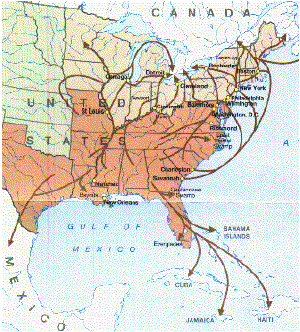
This map of selected routes of
the Underground Railroad
was created by the National
Park Service.
'Black History' segment
written in June, 1998 by David Lodge
[ Back to Black History Index ]
|