|
Fugitive Slave Laws
The retrieval of runaway slaves and indentured servants during the
early colonial period was not governed by law but by the prevailing attitude in each of
the settlements. As time passed, intercolonial rules, regulations, and official agreements
were implemented to maximize the apprehension of runaways.
In 1787, the adoption of the Northwest Ordinance (the Northwest
Territory, that included Ohio, ceded by Great Britain after the Revolutionary War)
provided: "There shall be neither slavery nor involuntary servitude in the said
Territory, otherwise than in the punishment of crimes, whereof the party shall have been
duly convicted; provided, always, that any person escaping into the same, from whom labor
or service is lawfully claimed in any one of the original States, such fugitive may be
lawfully reclaimed and conveyed to the person claiming his or her labor or service
aforesaid."
That same year, a "fugitive clause" was inserted into the
draft of the U.S. Constitution adopted by the Constitutional Convention that read: "No
person held to service or labor in one State, under the laws thereof, escaping into
another, shall in consequence of any law or regulation therein, be discharged from such
service or labor, but shall be delivered on claim of the party to whom such service or
labor may be due." Since the federal government was not vested with power to
enforce the issue, individual states were left to establish their own policy.
Congress passed the first Fugitive Slave Law in 1793, allowing oral
testimony of a claimant, to possession of an alleged fugitive slave, as sufficient right
to claim ownership. Following actual proof of ownership, the surrender of the fugitive was
mandatory, and a fine of $500 was to be levied on anyone attempting to conceal or rescue
such individual.
Other slave laws, appeasing the South,
would follow, only to be neutralized by personal-liberty laws enacted by the Northern
states. The vocation of slave catcher proliferated, with gangs of men terrorizing and
kidnapping free blacks in the North into a life of slavery. Frederick
Douglass, fearing for his freedom, left for England in 1845 where he gained prominence
and respect. He returned to the U.S. with enough donated funds to secure the official
purchase of his liberty.
One of the most notorious slave
catchers, Patty Cannon, operated a system throughout the Maryland area that functioned
like an underground railroad in reverse, in that her stations enticed black fugitives with
promises of help and assistance only to torture and murder some and to sell others back
into slavery. After killing a family of four, including two children, she was jailed to
await trial. She eluded the hangman’s noose by committing suicide in her cell, on
May 11, 1829.
In 1848, Delaware businessman Thomas Garrett, a Quaker who had given
40 years of his life to sheltering fugitives, was assessed $5,400 in damages after helping
a freed man to convey his enslaved family from Delaware to Philadelphia. Announcing that
he had always feared losing what little he owned, he added, "but now that you have
relieved me, I will go home and put another story on my house, so that I can accommodate
more of God’s poor." He also told the court, "...if any of you know of any
slave who needs assistance, send him to me."
The Fugitive Slave Law of 1850, designed to strengthen earlier laws,
brought further peril to those who ran away and those who assisted them. The right to
organize a posse to capture fugitives anywhere in the United States resulted in the
increased abduction of blacks as far north as New England and west to Ohio, where they
were taken from churches, homes and families. The criminal penalty for aiding a runaway
was six months in jail, a $1,000 fine, and a civil liability to the owner of $1,000 for
each fugitive. Another element of this law was that when an alleged runaway was taken
before a magistrate, the law prescribed that a judge who found in favor of the claimant
would collect double the fee he would collect if he ruled against the claimant. No
impediments were to be put in the way of those seeking to reclaim their slave property.
Under this law, legitimate free blacks were in fear of being claimed as runaway slaves. It
was referred to as "The Kidnap Law".
Almost the first federal case under the Fugitive
Slave Act of 1850 arose in Ohio whereby Washington McQuerry, a Kentucky runaway mulatto,
was arrested in Troy, Ohio, where he had lived for four years. Tried in a federal circuit
court in Cincinnati, the judge remanded him back to slavery.
The Dred Scott case argued before the U.S. Supreme Court in
1856–57 involved the status of slavery in the federal territories. Scott, a slave,
had been taken to Illinois and the Wisconsin territory, where slavery was prohibited by
the Missouri Compromise. Later, in Missouri, he sued for his freedom on the basis of his
residence in a free state and territory. The Supreme Court's Southern majority declared
that the Compromise was unconstitutional and that Congress had no power to limit slavery
in the territories. Three justices also held that an African American descended from
slaves had no rights as an American citizen and therefore no standing in court.
Thus was the great struggle over slavery between the North and South
that would end in the Civil War. The
Fugitive Slave Law was repealed in 1864, and other such laws were nullified by the passage
of the 13th Amendment to the Constitution in 1865.
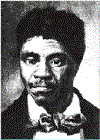
Dred Scott
'Black History' segment
written in June, 1998 by David Lodge
[ Back to Black History Index ]
|