Frederick Douglass
Orator and Abolitionist (1817?-1895)
"Prejudice against color is stronger North than South. It hangs around my
neck like a heavy weight."
Frederick Bailey was born into slavery, circa 1817, in Tuckahoe, Maryland,
the son of a slave mother, Harriet Bailey, and a white man. The cruel, inhumane, treatment
of blacks as slaves during his early years instilled in him
a passion to the abolitionist cause that would influence his entire life. Failing in an
attempt to escape to the North in 1836, 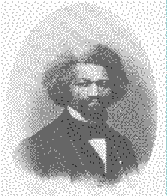 he eventually gained freedom two years later when
he fled to New Bedford, Massachusetts, changing his name to Frederick Douglass. In 1838 he
married Anna Murray, a free colored woman whom he had met in Baltimore. he eventually gained freedom two years later when
he fled to New Bedford, Massachusetts, changing his name to Frederick Douglass. In 1838 he
married Anna Murray, a free colored woman whom he had met in Baltimore.
His career as an
anti-slavery advocate began in 1841 in an impromptu speech to the attendees at an
anti-slavery convention. His eloquence and stylish oratory as, "a recent graduate
from the institution of slavery with his diploma on his back," caused the
Massachusetts Anti-Slavery Society to employ him as one of their agents. His speeches in
the northern states and his diligent national work for the Underground
Railroad, made him a beacon of hope for his brothers still enslaved in the South. He
served as the "station master and conductor" for the Railroad in Rochester, New
York.
His association and friendship
with the abolitionist, John Brown, was severed permanently
when Douglass objected to Brown’s forthcoming attack on the federal arsenal at
Harper’s Ferry. He failed to convince Brown that such action was an assault on the
U.S. government would have disastrous consequences, and the raid on the arsenal proceeded
without Douglass’ complicity or support.
After the Harper’s Ferry attack, even
though he was not involved, fearing reprisals, he fled to Europe returning six months
later to campaign for Abraham Lincoln in the 1860
presidential election. After the Civil War, he fought tirelessly for the enactment of the
13th, 14th and 15th Amendments to the Constitution. He went on to become a U.S. Marshall
for Washington D.C. (1877-81), recorder of deeds for D.C. (1881-86), and U.S. Minister to
the Republic of Haiti (1889-91). Douglass was a tireless proponent of equal rights. In one
instance, he had to be dragged bodily from a ‘whites only’ railroad car in
Massachusetts. He tore the seat out with him. Repeatedly beaten by mobs at various
appearances, Douglass is recognized as one of the greatest African-American orators of all
time.
'Black History' segment
written in June, 1998 by David Lodge
[ Back to Black History Index ] |