John Brown
White Abolitionist (1800-1859)
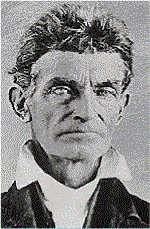
John Brown was a fiery
abolitionist and preacher who was born in Connecticut and, at the age of five, moved to
Ohio. His father’s repulsion for the institution of slavery had a lasting affect on
young John that would lead him to infamy in the annals of American history.
In 1833, he married teenager Mary Ann Day of
Meadville, Pennsylvania, who would bear him a total of 13 children (although only six
lived to adulthood). Starting in 1834, Brown began educating Negroes, and for the next
twenty years he, and his family, worked actively within the abolitionist movement. |
 |
| In 1855, he and five of his
sons, began abolitionist actions in the Kansas Territory, where in Lawrence, Kansas, a
group of abolitionists were murdered by pro-slavery forces. On May 24, 1856, he and his
sons avenged their death by killing five pro-slavery advocates. He was now nationally
known and supported by east-coast abolitionists and cultivated friendships with many of
them, including Frederick Douglass.
Brown’s infamous attack on the federal arsenal at Harper’s Ferry on
October 16, 1859, intended to strike a blow for anti-slavery forces, was courageous,
unfortunate and misguided. The attacking party of 21 men included Brown along with 3 of
his sons (John, Oliver, Owen). Comprised of 16 whites and 5 blacks, the group’s
average age was 25 years old. Taking prominent citizens as hostages, they occupied the
federal arsenal to reinforce their demand that slaves in the surrounding territory be
liberated. These slaves would give Brown a nucleus of men from which he would form an army
that would free the Negroes in the South. His desperate plan failed, when after being
surrounded by the local militia, they attacked Brown’s insurgents, wounded him, and
secured the rebels’ arrests on the morning of October 18. The militia, led by Colonel
Robert E. Lee, killed 10 of Brown’s men, including 2 of his sons.
He was executed on December 2, 1859, at Charlestown, Virginia (now
West Virginia), but not before he distinguished himself in an eloquent defense of his
actions on behalf of slaves. In a famous letter, written to his children on the eve of his
death, he wrote, in part, "I am as content to die for God’s eternal truth on
the scaffold as in any other way." His dedication to a cause, was, and is,
immortalized in the song, "John Brown’s body lies a-mould’ring in the
grave."
'Black History' segment
written in June, 1998 by David Lodge
[ Back to Black History Index ] |