|
Iron and Foundry
Not long after the first cabins appeared
around the square in Sidney, a need arose for basic iron products such as nails, hinges,
bolts, and horseshoes, creating a market for a village blacksmith.
Christian Kingseed was the first 'smithy' to open a shop. He arrived here in 1846
or 1847. His shop and forge was located at the northwest corner of North Street and Ohio
Avenue. Mr. Kingseed was the smithy who forged the ball and chains that were used to
shackle Alfred Artis on his
way to the gallows. Artis was hanged in 1855 on the courtsquare in Sidney for the murder
of his 12 year old daughter, Emma. John Heiser took over the the blacksmith shop when Mr.
Kingseed retired.
Plow manufacturing was another early industry for which
Sidney, Ohio, became well known. Christian Kingseed made a crude iron plow at his shop,
but the first person to develop the business was Daniel Toy. A native of New Jersey, Toy
lived briefly in Mansfield, Ohio, and a couple of other places before moving here with his
family in 1848. Toy made iron plows. There is evidence that Toy was the first person in
the country to make a steel plow, however, John Deere is given credit for the invention.
Soon after his arrival in Sidney, Daniel Toy went into business with David Edgar. Their
firm, the Toy and Edgar Plow Works, was located in Sidney's first courthouse building, which had been moved to
West Avenue between Court and Poplar Streets.
Daniel Toy, and his son, William Minor
Toy, engaged in the plow business at various locations around town for many years.
(William trained all four of his sons in the steel craft — Hugh worked for his
father, Dan and Robert worked for the Sidney Steel Scraper
Company, and William, Jr.) Daniel built plows used in the construction of the C.H.
& D. railroad through Sidney.
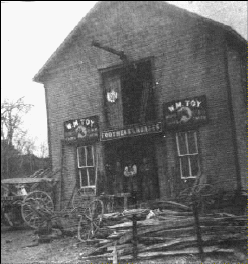
Factory of W.M. Toy and Company, located
at the corner of North Street and East Avenue in Sidney.
(Former site of Bridgeview
Middle School).
The Toys teamed up with G. G. Haslup (as Haslup
& Toy), Ben Slusser (Slusser Sulky Plow Works), Philip Smith, and others. W. M. Toy subsequently made street
maintenance equipment, metal snow plows for sidewalks, steel lawn chairs and steel street
trash cans.
A new age for S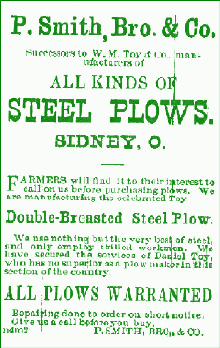 idney, Ohio, industry was born with the arrival in Sidney of
Philip Smith in 1859. With just $25, he started a small foundry with his brother, Michael.
Known as P. Smith & Bro., the business grew steadily. The Smith brothers made all
things metal, including metal wheel spokes and school bells. idney, Ohio, industry was born with the arrival in Sidney of
Philip Smith in 1859. With just $25, he started a small foundry with his brother, Michael.
Known as P. Smith & Bro., the business grew steadily. The Smith brothers made all
things metal, including metal wheel spokes and school bells.
A disastrous fire wiped out the budding enterprise in the 1860s. Various business
recessions had the firm teetering on the brink of failure. Philip Smith eventually bought
out his brother. His foundry was turning out 8,000 bells and 4,000 sugar kettles a year by
1879. Over the next four decades, Mr. Smith designed and manufactured such diverse items
as steam engines, fire escapes, metal building columns, grain handling equipment, washing
machines, and cookware.
Among their other products were cast iron architectural elements; cornices, window hood
molds and particularly storefronts. A Philip Smith Foundry storefront nameplate can be
seen on the Piper Building (120 South Main
Avenue, facing the alley) and at 116 West Poplar Street (just east of the Sidney Theater).
The West Poplar Street building is one of the few Smith iron storefronts which survives
intact.
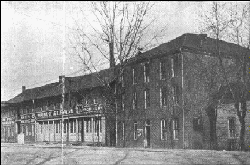
The business was incorporated as the Philip Smith Manufacturing Co.
It
was located on the southeast corner of Main Avenue and Shelby Street.
Industry segment
written in January, 1998 by Rich Wallace
[ Back to Industry Index ]
|