|
Prisoners of War
Large concentrations of
troops, hand to hand combat, and the confusion of battle resulted in many soldiers on both
sides being captured. The average soldier showed little animosity toward his adversary.
The 20th's spy and scout C. L. Ruggles once recognized a
Confederate prisoner he had known before the war. After exchanging pleasantries, the
prisoner inquired about the Union's chances of bringing the states back together. "Do
you expect to pin the states together again with bayonets?" he asked. Ruggles
replied, "I don't know whether we shall pin the states together again or not; b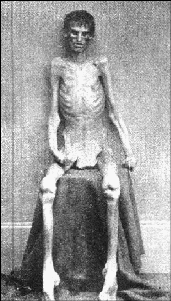 ut
I do know one thing, we'll have the soil back again, whether we have the people or
not." ut
I do know one thing, we'll have the soil back again, whether we have the people or
not."
Prisoner of war
camps were plentiful in the north and south. Libby Prison in Richmond, Virginia, and
Andersonville, located in southwestern Georgia, were the most well-known Confederate
prisons. Johnson's Island on Lake Erie, Camp Chase, just west of what is now downtown
Columbus, and the Ohio State Penitentiary in Columbus were where many rebels were taken.
Union and Confederate prisons alike were notorious for their miserable, unsanitary
conditions.
The captured soldiers hoped to be part of
routine prisoner exchanges, which were common until General Grant ordered a halt to them
in late 1864. In a speech to the Neal Post of the GAR as
reported in the "Sidney Journal" on November 13, 1896, Sidney's Dr. W. H.
Shaw told how he was knocked unconscious by the concussion from a bursting shell at Stones River, captured, and taken to Libby Prison for four
months. He responded to the name of a dead comrade at a prisoner exchange roll call, and
was released. With no money and no papers (traveling at night to avoid arrest), he
walked north, eventually arriving at Crestline, Ohio. A former Sidney resident recognized
him, fed him, and put him on a train for his home town.
Dr. S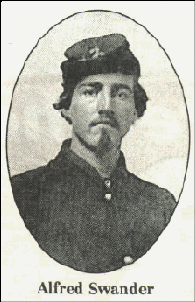 haw
was one of the few lucky ones. Cavalry soldiers Francis Honnell of Port Jefferson,
Nehemiah Baldwin, 16 year old Thomas Powell, and Levi Bird were imprisoned, along with
Shelby County soldiers James Morris, George Ragan, William Borum, Thomas Duncan, Alfred Swander, George Baldwin
and Theophilus Ailes. All died in southern prisons. haw
was one of the few lucky ones. Cavalry soldiers Francis Honnell of Port Jefferson,
Nehemiah Baldwin, 16 year old Thomas Powell, and Levi Bird were imprisoned, along with
Shelby County soldiers James Morris, George Ragan, William Borum, Thomas Duncan, Alfred Swander, George Baldwin
and Theophilus Ailes. All died in southern prisons.
99th Ohio soldier Joseph Wilkinson survived an incredible 18
months in Libby and Andersonville. Of the latter, he said after the war: "Our
clothing had become so ragged and tattered it scarcely covered our nakedness. Mortality
thinned our ranks, and our prison was a charnel house. Rations were reduced. For four
months one pint of coarse corn meal was a daily ration."
The June 29, 1924, edition of the "Shelby
County Democrat" carried a personal account of life in Andersonville by William
Brown, who was then 85. "I was a strong youth of average weight when I entered
Andersonville. When I was released I weighed only 75 pounds. We each received one oyster
can of corn gruel a day for five days, the other two days we got nothing at all. One time
a dog got into the stockade...and it was soon a case of 'doggone' when we got him. The dog
meat enabled us to live pretty well for a few days afterward." Brown still had in
his possession a medal given to the survivors of the prison bearing the motto "Death
before dishonor."
'Civil War'
segment written in July, 1998 by Rich Wallace
[ Back to Civil War Index ]
|