|
Randolph Slaves Come to Ohio
After a journey of nearly 500 miles, the
slaves arrived in Charleston on June 18. They had traveled through Virginia, crossing the
Greenbrier River through Lewisburg, the Sewel Mountain over Hawks Nest, around the Kanawba
Fall, down the east bank of that river and onto Charleston. They boarded a steamer on the
Kanawha River and sailed on to the Ohio River and the city of Cincinnati. They entered the
city on July 1, 1846, with accounts of their arrival appearing in the July 2 edition of
the local newspapers. "The Gazette" account berates their benefactor John Randolph, perhaps unjustly, for his presumed hypocrisy,
and provides an insight into the humanitarian contradictions of whites in non-slave
states. The entire account appears below:
"John Randolph, by will, gave freedom to his slaves,
and provided the means for their settlement in Ohio. Yesterday they passed through our
city on their way to the settlements purchased for them in the interior. The troop was a large one. There appeared to
be some three hundred [383] in it. It is composed of people of all ages and all sizes, and
attracted no little attention."
In themselves, as they marched along, they bore testimony against
Slavery. Their master had enjoyed the benefit of their services while he lived. For him
they toiled. They worked daily, year in and year out; but the sweat of their face was
spent for another, and not for themselves. Was this just? Death drew nigh; he felt its
approach; and when told he must pass away, he summoned all his energy, as he remembered
his slaves, and the various contradictory wills he had made with regard to them, and,
also, what they had done for him, and said to the Physician by his side, "Remember,
they are free. He would be just to them ere he met his God. He dares not die with the
iniquity of human bondage resting upon his soul.
Well—they are free! The boon of mankind is theirs. But are they
prepared to enjoy it? Their old master had means enough out of their labor to prepare them
all for this step. He could travel in foreign lands; sport and spend freely on the race
course; scatter profusely, or hold closely the money made by them, as fitful gleams of
generosity, or hard gripings of avarice, seized and controlled him. For self, he would do
as whim or caprice directed; but for them, in the way of enlightenment, he did nothing
[editor’s note: sources indicate that Randolph took great interest in the educating
and care of his slaves]. And it was not till life’s doings were spread out before
him, and all of the past was concentrated in the brief hour of death, that he had the
courage to declare orally that they should enjoy, untaught and unprepared as they were,
what God meant should be common to all his creatures —freedom!
And now the poor creatures are among us! — Why should this be?
We have nothing to do with Slavery, and it is neither our interest, nor our duty, to add
to the ignorance of our State, in any way. Let us recall, in part, this remark. —This
emigration of John Randolph's Negroes proves that we have something to do with slavery.
And evidently, the people of Virginia think so too. —For whenever their eyes get
opened, because they hear the call of death, or know it is nigh, the first step is, to
free their slaves, that they may lull the unquiet knawings [sic] of conscience —the
next to send them to Ohio, that they may be free! We have already several colored
settlements among us. —And pray, why does not Virginia and Kentucky retain their
freed blacks? What right have they to be pouring in upon us their helpless, new made free?
We have very much fear that the common objection made in the Slave States, that we, as
Free States, having nothing to do with Slavery, will turn out, on examination, to be
eminently untrue, in more respects than one."
After boarding Miami & Erie Canal barges on Main Street in Cincinnati, they
began their journey north to Mercer County. Arriving in Dayton, the local newspaper
reported some of the former slaves’ apprehension about their destination and the mood
prevalent in Mercer County with these words. "They are a fine looking company of
blacks. Some of them regretted being compelled to leave Virginia, where they would much
rather have remained, and anticipated an unfavorable reception in Mercer County. Since the
arrangements for settling the Randolph blacks in that county have been in progress, a
great deal of opposition has been manifested by the citizens, and meetings have been held
in the various parts, at which resolutions were passed to take measures to prevent these
Negroes from coming into the area. We have no idea that they will be permitted to remain
in Mercer County."
Signs of racism followed them
north through Tippecanoe (Tipp City) and Troy before their arrival in Piqua, where the
Town Marshal refused to allow them to disembark to quench their thirsts, ostensibly,
because of a water shortage, and insisted that they move on. It is believed that
compassionate individuals in the Johnston Farm area of the canal allowed the party to drink from a spring on the property.
Continuing north on the canal, the barges moved into Shelby County,
passing through the locks at Lockington on to Berlin (Ft. Loramie) where they were not allowed to
land, and their final destination New Bremen, Mercer County (Auglaize County was not
created until 1848), where the promised land, detailed in Randolph’s will, was
waiting for them. Upon their arrival in New Bremen, they disembarked, made camp, and
wagonmaster Cardwell contacted the local residents who, by now, had, in a mass meeting,
determined a course of action unfavorable to the Randolph group. Cardwell’s
humanitarian plea for the blacks, their rights, and the various resolutions he proposed to
resolve the problem were rejected.
That same evening, a mob of whites, fully armed with guns and
bayonets, surrounded the camp; reading three resolutions that included the following,
"Resolved, That we will not live among Negroes; as we have settled here first, we
have fully determined that we will resist the settlement of blacks and mulattoes in this
county to the full extent of our means, the bayonet not excepted." Taking
Cardwell into custody, they forced him, on the next morning, to charter two canal boats to
remove the blacks from their county. With an armed citizen escort, the boats—with
their occupant’s dreams and aspirations shattered, replaced by uncertain
futures—left Mercer County.
They eventually disembarked close to Piqua (an area that became Rossville, a Randolph slave community) in Miami County where
charitable whites brought them food. They also later located in Sidney, Troy and West
Milton and in other small communities like Hanktown and Marshalltown. An editorial in the
Sidney newspaper, "Aurora", condemned the Mercer County residents for
selling land to the Negroes, receiving wages for constructing buildings and pocketing
"a large amount of money for provisions not two weeks before the arrival of the
poor creatures whom they so unjustly treated."
Within a few days of stopping near
Rossville, the contingent headed for Sidney and Shelby County, as reported in the Piqua
newspaper, "As we noticed last week (July 18) an effort, which it was thought
would be successful, was made to settle them in Shelby County, but like the previous
attempt in Mercer it failed. They were driven away by threatened violence. About one-third
of them, we understand, remained in Sidney, intending to scatter and to find homes
wherever they can." Leonard Hill’s Randolph article adds that Shelby County
did eventually become the final resting place for "Old Quasha," 90 years of age,
who once had been Randolph’s head wagoner.
In a
subsequent trial involving the former slaves’ land in Mercer County, testimony by
Clem Clay (former slave) indicated that the group went first to Carey’s Plantation,
believed to have been in the Berlin (Ft. Loramie) area. A piece in the July 14, 1893,
edition of "The Sidney Journal", recounts their reception in Berlin and
states, "In July of 1846 quite a commotion was caused in the village by the
arrival of a boat carrying as passengers...about 100 Randolph slaves, just set free. The
boat passed up to the vicinity of Berlin but were not allowed to land. A mob received them
with sticks and stones...it was the exclamation of one of the old Negroes that he guessed
his master [referring to Randolph] was his best friend, after all."
Clay goes on to tell about their visit to Sidney, the mob that
gathered, and, as reported in the "Piqua Register", threatened violence.
To avert a confrontation, Guy Kelsey, local businessman (grocer and wholesale liquors) who
was also Clinton Township treasurer in 1846, and Joseph Cummins, a co-partner in the
platting of Pulaski (a settlement in Van Buren Township close to Rumley), and a later
Clinton Township overseer/trustee, and other citizens, met in a Sidney hotel to discuss
the issue. It was decided to allow a number of the former slaves to stay in Sidney, and
that, in Clay’s words, "Well, a good class of white people took some on the
farm and some around to the dwelling houses...some settled around Sidney...and the rest
came to Piqua."
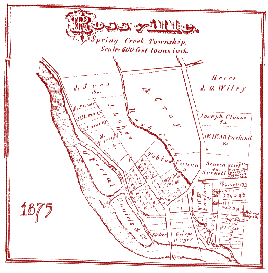
It is also known that a number of them settled in Rumley, a black community (whites also lived there), that had been
platted in 1837 northeast of McCartyville in Van Buren Township of Shelby County.
The rest of the Randolph slave family, as Clay mentioned, left for
Piqua, and then for Troy, and villages in western Miami County where they were employed by
Quakers sympathetic to their plight. Piqua and Troy, at the time, already had a few black
residents, and Troy had a separate black school. The slaves hired themselves out as hands
on neighboring farms, doing odd jobs and picking up work as it came along. The freed
slaves with construction skills helped build a variety of structures, including several
homes still standing in Piqua. The 1850 U.S. Census indicates figures for black citizens
(many were probably from the Randolph party) as: Piqua and Springcreek Township 67; Troy
33; Covington and Newberry Township 39, Newton with Pleasant Hill 36; and Union with West
Milton 91.
Beginning on December 16, 1846, Joseph
Plunkett, the man William Leigh trusted to represent the freed slaves interests, began to
sell the unclaimed land. Helen Gilmore has found evidence
that when the former slaves inquired about the land that was rightfully theirs, it had
been flooded by water temporarily released from Grand Lake St. Marys. Over a seven year
period, Plunkett sold all the land for a total of over $7,700. Gilmore also states that
the treacherous Plunkett, in selling the land, forged the name of William Leigh.
'Black History' segment
written in June, 1998 by David Lodge
[ Back to Black History Index ]
|