| Randolph
Slave Settlement
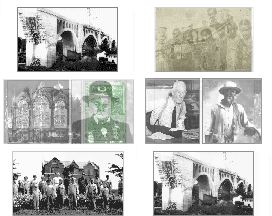
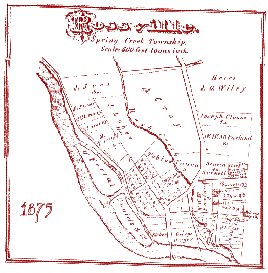
Rossville originally occupied the land
north of the Great Miami River on both sides of 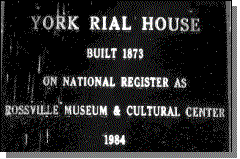 County Road 25A. Today, the last vestiges
of Rossville are still north of the river, and centered around Zimmerlin Road which
intersects with 25A. Helen Gilmore, Piqua historian,
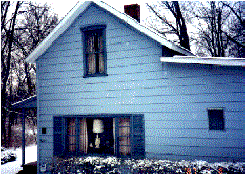
maintains the Rossville Museum and African-American Cultural Center, 8250 McFarland
Street, situated on the site (pictured at top right). [It is open M-Fr., 1-7 p.m.,
weekends by appointment. Call 937-773-6789]. Displays portray African-American history
in the Rossville/Piqua area, the nation and the continent of Africa. The museum building
is the original York Rial (Randolph slave, ancestor of Helen Gilmore) home listed on the National Register of Historic Places. Added in
December, 1986, it was one of the first black residences to be listed on the Register. County Road 25A. Today, the last vestiges
of Rossville are still north of the river, and centered around Zimmerlin Road which
intersects with 25A. Helen Gilmore, Piqua historian,
maintains the Rossville Museum and African-American Cultural Center, 8250 McFarland
Street, situated on the site (pictured at top right). [It is open M-Fr., 1-7 p.m.,
weekends by appointment. Call 937-773-6789]. Displays portray African-American history
in the Rossville/Piqua area, the nation and the continent of Africa. The museum building
is the original York Rial (Randolph slave, ancestor of Helen Gilmore) home listed on the National Register of Historic Places. Added in
December, 1986, it was one of the first black residences to be listed on the Register.
York Rial and Joseph Moton spearheaded the effort in 1907 that
eventually included 27 cases where nearly 170 of the remaining black heirs brought suit to
recover the cash or land that John Randolph originally
willed them. After a 10 year battle, with an appeal to the Ohio Supreme Court and the
United States Supreme Court, the Mercer County Court of Common Pleas found in Joseph
Moton et al. v. Gerhard Kessnes that Ohio’s 21 year statute of limitations barred
the black’s recovery. Two higher courts let the opinion stand. York Rial perished in
the flood of 1913.
 Also located on the site is the (African) Jackson Cemetery that
began with the freed slaves arrival in the area and their establishment of Rossville. The
Randolph slaves bought land from William and Freelove McFarland. It was initially called
the African Cemetery, then later Jackson Cemetery. Of the 120 buried there, 9 men served
in the Civil War. Also located on the site is the (African) Jackson Cemetery that
began with the freed slaves arrival in the area and their establishment of Rossville. The
Randolph slaves bought land from William and Freelove McFarland. It was initially called
the African Cemetery, then later Jackson Cemetery. Of the 120 buried there, 9 men served
in the Civil War.
The houses in Rossville were built
on the same order as the slave’s houses in Roanoke, Virginia, on the John Randolph
plantation. Rossville is the only surviving settlement of the three that were formed in
the area by the Randolph slaves. The other two, Hanktown (near West Milton), and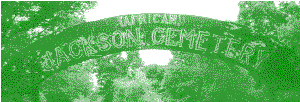 Marshall
Town (near Troy) have long sincedisappeared, making the preservation of the Rossville
Historic District and its listing on the National Register of Historic Places a priority
of historic importance to Helen Gilmore and her supporters. The Rossville Springcreek
Historical Society, Inc., was formed in 1978 by Helen Gilmore and Florence Scott. Marshall
Town (near Troy) have long sincedisappeared, making the preservation of the Rossville
Historic District and its listing on the National Register of Historic Places a priority
of historic importance to Helen Gilmore and her supporters. The Rossville Springcreek
Historical Society, Inc., was formed in 1978 by Helen Gilmore and Florence Scott.
'Black History' segment
written in June, 1998 by David Lodge
[ Back to Black History Index ]
|