John Randolph Slaves
Leonard U. Hill, the late Piqua historian, in
his article published in the Cincinnati Historical Society newsletter of July 1965,
describes the venerable John Randolph as being among the "First Gentlemen" of
colonial Virginia. Randolph (1773-1833), boasting the Indian princess Pocahontas as one of
his ancestors, was elected to Congress in 1799, where he soon became the Democratic party
leader. He disagreed with Thomas Jefferson frequently, opposed the declaration of
war in 1812 against Great Britain, and vigorously argued against the expansion of slavery
into the new state of Missouri. He also opposed President Andrew Jackson on the
nullification question (Randolph was in favor of nullification), a political theory, based
on states’ rights, that allows individual states to suspend federal laws within their
boundaries. Although there are proponents of nullification today, the last time Federal
law was nullified was at the outset of the Civil War when South Carolina, followed by
other southern states, seceded from the Union.
|
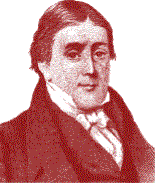
John Randolph |
| Randolph served in the U.S.
Senate from 1825 to 1827, and in 1830 he was appointed minister to Russia. John
Randolph, politician, statesman and owner of a 6,000 acre plantation and hundreds of
slaves, was an emancipationist who died in 1833 leaving three wills, two of which
manumitted (freed) his slaves. The earliest will, dated 1819, specified, "I give
and bequeath to all my slaves their freedom, heartily regretting that I have ever been the
owner of one."
Other provisions set aside $8,000 for
transporting and settling his freed slaves in another state or territory of the United
States. Each former slave above the age of 40 was to receive no less than 10 acres of land
in this new place. Codicils of 1826, 1828, and 1831 were added, with the 1828 supplement
reading, "Being in great extremity, but in my perfect senses, I write this codicil
to my will in the possession of my friend, Wm. Leigh (Leigh was Randolph’s cousin),
of Halifax, esquire to declare that will is my sole last will and testament, and that if
any other be found of subsequent date whether will or codicil, I do hereby revoke the
same."
His final will written in 1832 upon his return from Russia, in
Europe, directed that the bulk of his slaves be sold. Upon his death bed it is reputed
that his final thoughts, after never being married, were about his slaves, their welfare,
and that they should be manumitted.
Claiming that John was
insane, his brother contested the will and kept the slaves. It would be thirteen years
before the courts would reach their decision to accept the "instrument of
writing...the codicil whereto bears date the 5th day of December 1821...the
codicil...1821...the codicil...of January 1826 the four codicils bearing date the 6th date
of May 1828...and the codicil bearing date the 26th day of August 1831...Therefore it is
ordered that the said several instruments of writing be recorded as the true last will and
testament of the said John Randolph of Roanoke deceased."
William Leigh began the process of carrying out the will’s dictates by
traveling to Mercer County in western Ohio to arrange for the settlement of the newly
freed slaves. According to Leonard Hill and Helen Gilmore,
(a Rossville, Ohio, historian), William Leigh, on behalf of
the Randolph will dictates, had bought about 3,200 acres of fertile land in Mercer County
for over $6,000. It is possible that Leigh was aware of the black settlement of Carthagena, Mercer County, that had been established by a
Quaker, Augustus Wattles, in the 1830s.
Some of the land purchased was close to Carthagena, however, the
bulk of it was in the Celina vicinity. Before returning to Virginia, Leigh contracted with
Joseph Plunkett of Mercer County, to attend to the interests of the new arrivals and to
ensure their settlement. It was June 10, 1846, when 383 former slaves urged their horses,
four to a wagon, pulling sixteen wagons loaded with everything they owned, to head west
toward the free state of Ohio. Their ages ranged from a little baby less than 12 months to
Granny Hannah who was reputed to have been over 100 years old. They were led by Mr.
Cardwell, wagon master, whom Leigh had retained to assist the former slaves in their long
journey, and to oversee their successful settlement in Ohio.
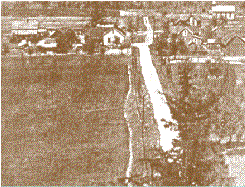
Carthagena in 1935
Cardwell probably had in
his possession the extremely valuable certificate of their freedom, which stated,
"...A true list and description of the Negroes and mulatto emancipated by the will
of John Randolph of Roanoke, dec’d, recorded in the General Court of Virginia, made out from the general
book of registers of free Negroes and Mulatoes(sic)...approved by the said court the 4th
day of May 1846.
The document listed all their given
names (a few had surnames listed; most took them at a later date), and their complexion,
height and age. According to Gilmore, "They
examined them from head to toe and wrote down any marks you had on you...made you feel
like you was cattle or pigs. Every slave had a number."
Written on the 12 page list of former slaves, numbered 215 to 596,
was No. 514 - Shadrach, who would take White as a surname (later known as Buddie Shang) and make Sidney
his home, and No. 421 - Carter who would choose Lee as his surname, settle in New Bern,
located outside Sidney on Hardin-Wapak Road at Schenk Road, and produce an offspring that
would lead to the birth of James P. Humphrey,
Sidney’s first black mayor.
According to Humphrey, a Frank Brown settled in Sidney in the Fair
Road area. Also listed was Rial, known later as Jimmie Jeems Rial (shown at right) an
ancestor of Helen Gilmore. NOTE: A slave did not have a last name until free. When freed,
he/she often took the name of his/her master, residence or of some famous person of that
time.
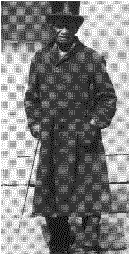
Jimmie Jeems Rial 'Black History' segment
written in June, 1998 by David Lodge
[ Back to Black History Index ] |