|
Anti-Slavery Efforts
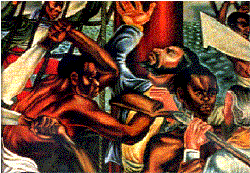
Hale Woodruff - "Mutiny Aboard the Amistad," 1939
By the 1830s, new
abolitionists throughout the north were raising their voices against slavery. Some of
these vocal whites were William Lloyd Garrison, Lucretia Mott, Lewis Tappan, and Theodore
Dwight Weld, who were soon 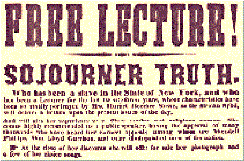 joined in their anti-slavery crusade by such former slaves as Frederick Douglass, Highland Garnet, Harriet Tubman, and Sojourner
Truth. They condemned slavery in articles and speeches, with Garrison starting his own
anti-slavery press (1831) in the form of a publication, "The Liberator". Douglass, the most influential black leader at that time, also began an abolitionist
newspaper in 1847 called the "North Star". Like other abolitionists, he
considered Ohio an important antislavery advocate because it was the oldest, richest and
most populous of the western states. Visiting for the first time in 1843, he later wrote
in 1849 that annual conventions were "more faithfully and regularly held than
those of the colored freemen of any other state in the Union." joined in their anti-slavery crusade by such former slaves as Frederick Douglass, Highland Garnet, Harriet Tubman, and Sojourner
Truth. They condemned slavery in articles and speeches, with Garrison starting his own
anti-slavery press (1831) in the form of a publication, "The Liberator". Douglass, the most influential black leader at that time, also began an abolitionist
newspaper in 1847 called the "North Star". Like other abolitionists, he
considered Ohio an important antislavery advocate because it was the oldest, richest and
most populous of the western states. Visiting for the first time in 1843, he later wrote
in 1849 that annual conventions were "more faithfully and regularly held than
those of the colored freemen of any other state in the Union."
Tubman and others were instrumental in the promotion of the underground railroad, a term used to describe a network of
routes and safe houses that stretched from the slave states to freedom. Blacks fleeing
slavery were guided along these routes, and sanctuaries, until they reached safety.
Throughout the history of slavery in North America, many slaves rightfully protested their
plight, and impoverished conditions, by subtly destroying property, disobeying orders, and
feigning illness. Others escaped their bondage, while many participated in the almost 200
revolts and mutinies that occurred, including the 1831 uprising in Southampton County,
Virginia, led by Nat Turner, preacher and slave, resulting in the death of around 60
whites before it was quelled. The Turner insurrection, followed by his execution, caused
the South to reinforce its slave codes and restrict manumission (liberation).
La Amistad was a Spanish
ship, engaged in the now illegal slave trade, that set out from Africa in 1839 with its
cargo of Negro humanity bound for enslavement in  the Americas. Upon reaching the
coast of Cuba, the slaves broke free of their chains and a bloody confrontation with the
crew occurred. With their slave leader, Joseph Cinque, a Mende tribesman, in control
of the ship, the 53 slaves ordered the remaining crew members to return the ship to
Africa. The Amistad was eventually seized off Long Island by an American warship
where the mutineers were imprisoned for piracy, thus beginning an extradition court case
with international ramifications that would not be resolved until 1841. the Americas. Upon reaching the
coast of Cuba, the slaves broke free of their chains and a bloody confrontation with the
crew occurred. With their slave leader, Joseph Cinque, a Mende tribesman, in control
of the ship, the 53 slaves ordered the remaining crew members to return the ship to
Africa. The Amistad was eventually seized off Long Island by an American warship
where the mutineers were imprisoned for piracy, thus beginning an extradition court case
with international ramifications that would not be resolved until 1841.
Abolitionists, recognizing the importance of the case to their cause, seized
the issue, and the plight of the slaves, taking it through lower courts to the Supreme
Court. President Martin Van Buren wanted the defendants returned to Spain in compliance
with the wishes of Queen Isabella’s advisors (the Queen was eleven years old), and
her government. Their fate in Spain, would have, no doubt, been quick and final. Former
President John Quincy Adams represented the defendants before the Supreme Court where he
won a decision that maintained that the Negroes, originally kidnapped and forced into
slavery, were by international law, whichprohibited the slave trade, free men. Upon
receiving their freedom, charitable donations paid for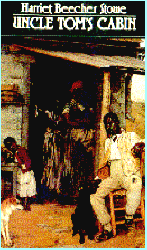 their return voyage to their
homeland, Africa. (In December, 1997, the movie "Amistad" was released by Steven
Spielberg depicting this event on film). their return voyage to their
homeland, Africa. (In December, 1997, the movie "Amistad" was released by Steven
Spielberg depicting this event on film).
On June 5, 1851, a
Washington D.C., abolitionist journal, the"National Era", published thefirst installment of a novel titled, "Uncle Tom’s Cabin", byauthor
Harriet Beecher Stowe. The final installment appeared in the April 1, 1852, issue, leaving
many Americans in a state of pathos and sincere concern for the plight of black slaves. Ina meeting with President Lincoln, he is reputed to have
said, "So this is the little lady who made this big war."
"The Shelby County Democrat" of February 10, 1854, printed, "On Thursday of last week there was an arrival of thirty four Negroes in our village;
originally belonging to the estate of a Mr. McColgan of Kentucky [a slave state] who by
his will set them free, leaving a considerable amount of property to be applied to the
purchase of land for them. We learn that they are to be located in this county."
'Black History' segment
written in June, 1998 by David Lodge
[ Back to Black History Index ]
|