| As the 20th
century draws to a close, the Sidney Daily News is publishing a series of special inserts
entitled "A 20th Century Diary," which traces the major events of our community
in this century. Few local businesses have stood the test of 100 years of change. One of
those which has, celebrates its 100th anniversary this week. In many ways, the employees
and managers of this institution have helped guide our community on its successful journey
over the last 100 years. This is the story, in brief, of Firstar Bank.
The original First National Bank actually organized here in 1864,
but only lasted 13 years, closing its doors in the financial panic of 1877. The major
player in the financial circles of western Ohio near the turn of the century was Lafayette M. Studevant. The Sidney
resident formed the Peoples
Savings and Loan Association in 1886. His financial prowess had resulted in his
appointment as a national bank examiner by the Comptroller of Currency for President
Grover Cleveland in 1888.
Studevant saw the need for a national bank in Sidney as a result of his work as a bank
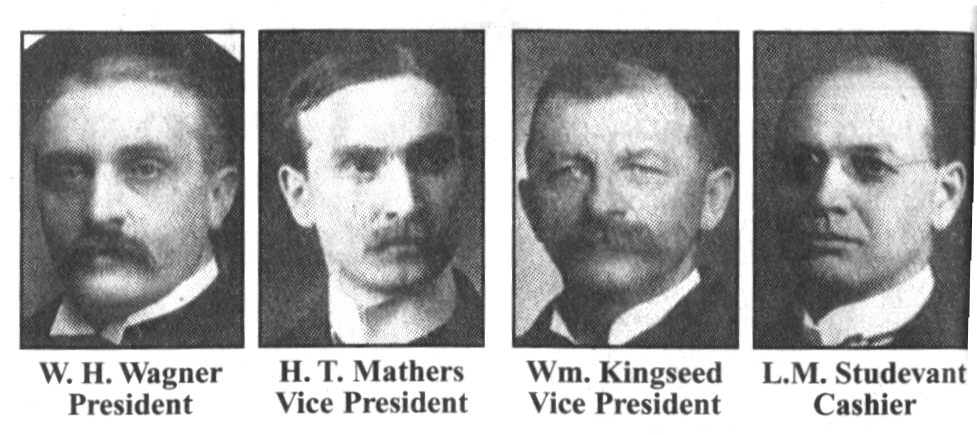
examiner. Along with W. H. Wagner, William
Kingseed, W. T. Amos, C. R. Benjamin, A. J. Hess and others, he
applied for authority to organize the county's first national bank. Many of the first
directors at the new bank had joined him earlier in founding Peoples, thus forming an
integral working relationship between the two institutions which has lasted to the present
day. First National, in fact, shared space with Peoples from its inception until it
occupied the old German American Bank space at 114 East Poplar Street in 1905.
Those leaders who formed the new venture, called the First National Exchange Bank, were
also active in the Commercial
Club. That group was successful in enticing many new businesses here, such as the
Bimel Buggy Company, the Underwood Whip Company, and the Buckeye Churn Company. These
growing firms needed capital, and "First National," as it was usually called,
began to grow immediately. Its first day of operation was September 18, 1899. Total
deposits in the bank exceeded $64,000 after just 65 days of operation. Gun-shy local
investors apparently liked the guarantees of "safety and government supervision"
which a national bank like First National could provide, and First National touted those
advantages in its ads.
Mr. Studevant served as cashier of the bank until 1906, but
his association with First National spanned nearly four decades. He was on the board from
1899 until 1938, and also served as president for seven years. Other business leaders who
led First National in its early years were W. H. Wagner, J. C. Cummins, and W. R.
Anderson. Harley Knoop and Cliff Hoying successfully guided the bank in its growth years
of the 1960's and 1970's.
The Board members decided to move into the
old German American Bank space on Poplar Street. Thus began an interesting chapter in the
bank's history. With what transpired over the next two decades, one must wonder whether or
not the building was jinxed. When the German American Bank failed in 1904, a number of
wealthy families and several businesses were forced into bankruptcy.
Just a few years
after the bank moved in, the first tragedy occurred. Charles Pfefferle, a barber who
operated his shop in the basement of the bank's building, went to work one morning in a
despondent mood. He was found by his son, dead, sitting in his barber chair. He had
committed suicide with a handgun. Another tragedy struck in 1914, as what most think
was the worst fire in Sidney's history destroyed much of the north side of the square, including this space. First National Bank
employees again moved in with the Peoples Savings and Loan operation until their new
structure was completed..
Undoubtedly one of the proudest moments in the bank's history was when the doors of its
fabulous new facility were opened for the first time on August 17, 1916. The rebuilt space
at 114 East Poplar, now completely fireproof, was breathtaking. The Daily News described
it as follows: "It is built entirely of Colorado Yule marble. Two magnificent
Corinthian marble columns, 22 feet high, grace the handsome entrance. On entering, one is
immediately struck by the intense beauty...of the interior. The ceiling is 28 feet high
and is of art glass...The counters are of mahogany and marble."
The open house the bank held was one of the social events
of the season. An amazing 3,000 people attended, constantly streaming through the gleaming
facility. J. F. Studevant, the father of the bank's founder, belying his 90 years, met
every guest at the front door throughout the day. By all appearances, it was the dawn of a
golden age for First National Bank.
Perhaps it was the German American jinx again, but the location held one more surprise.
Just after the bank opened on May 11, 1926, six robbers burst into the lobby. When cashier
J. C. Cummins feigned ignorance when asked to open the safe, one of the thieves hit him
over the had with his gun. After five minutes of quick work, they escaped with $35,000. Police Chief O'Leary and Sheriff
Dilbone combined to catch and convict three of men by the end of the year. They each
received the maximum sentence of 25 years in prison.
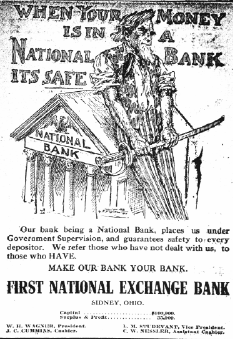
Sidney Daily
News advertisement
Although the Depression years were difficult,
and the payment of dividends were suspended, First National Exchange Bank survived and
ultimately prospered once again. The first drive-in bank in the county was opened by First
National in 1956. Located at the rear of its Poplar Street property, it had the first
underground currency transfer system ever built in the country. It was used to safely
transfer money into the main facility.
The bank opened its first branch bank in 1960 on
West Michigan Avenue, followed by a number of others. The West Michigan was the site of
three of the most notorious robberies in Sidney history, all committed by the same person.
The third time was not the charm for the lone, masked gunman, who was caught and shot in
the third robbery. Lloyd Blackford fired shots at Police Chief Warner, and one of the
bullets lodged in his holster. Blackford was convicted.
The need for a larger downtown banking facility resulted in the decision to purchase
the Court Street location of the Sidney Printing
and Publishing Company and build a new facility. First National's headquarters were
moved in April 1977.
The trend of consolidation among financial institutions involved First National
Exchange Bank in several instances. It acquired the Loramie Banking Company in 1981and the
Farmers and Merchants Bank of Anna 3 years later. After 89 years of independent existence,
the bank was the object of an acquisition. The bank was acquired by Star Bank in 1988.
Another acquisition by Star Bank resulted in the bank changing its name to Firstar in
1998.
As the bank's 100th anniversary arrives, it is interesting to speculate on what values
and business principles have contributed to its prosperity and durability. Perhaps the
answer can be found on the facade of the Court Street structure. Conceived and planned by
Bill Ross and Karl Freytag, the cast aluminum sculpture contains 20 elements. They depict
the key factors that have contributed to the progress of both the community and the bank.
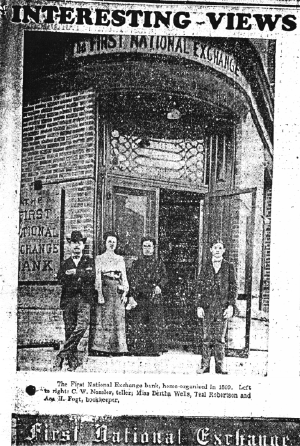
Above are some of
the early employees of the First National Exchange Bank, now known as Firstar.
Shown are: L-R C.W. Nessler, teller; Miss Bertha Wells; Teal Robertson; and Asa H.
Fogt, bookeeper.
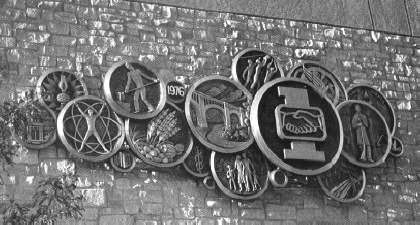
A sculpture created
by the nationally-known artist Robert Koepnick graces the exterior of the Firstar Bank in
downtown Sidney. Bank officials noted the sculpture reflects the institution's role
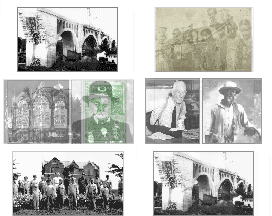
in Sidney's development and incorporated some of the town's landmarks, such as the Big Four Bridge. The facade was
planned by Bill Ross and Karl Freytag.
The central medallion contains the logo of
the bank. It features clasped hands superimposed over the number "1",
emphasizing the role of the bank in the community. The pamphlet printed by the bank
describing the sculpture provides a fitting summary: "The bank has joined hands with
the citizens of Sidney and Shelby County in promoting and encouraging, in many ways,
individual. business and community growth. A continuation of this objective is embodied in
the bank's slogan: Mutual Trust-Mutual Growth."
[ Back to Downtown Index ] |