|
Indians in Sidney and Shelby County
Each Shawnee village had three chiefs who had
individual responsibilities consistent with their titles — village chief, war chief,
woman chief, with a large number of them living in Shelby County. After the War of 1812, more than 6,000 Indians had settled near Indian Agent
Colonel John Johnston’s home in Piqua, (the British
government and some of the colonies appointed Indian Agents to work with the natives and
encourage trade). George Croghan, the trader mentioned earlier in relationship to Fort Pickawillany, was also an important Indian Agent.
Although most Indians living in Shelby/Miami Counties were peaceful, there were some
troublemakers.
In Miss Ann Conklin’s recollections of Sidney in the early years
after it was platted, "[a building] was owned by a man named Beatty, whose principal
occupation seems to have been the selling of the roughly distilled whiskey made in the
vicinity. Such as it was, it was eagerly drank by the Indians, of whom there were then
plenty, on their way to and from the office of the agent, Johnston, at Piqua. One hundred,
or more, on their ponies, in all their savage trappings, was no unusual sight in Sidney in
those days."
Another Sidney newspaper column [undated] written by Blanche Gearhart on the
‘Early History of Sidney’ stated that "an old fort stood on Main street
near the present site of the Catholic church. Twenty-five or thirty men were stationed
there as protection against the Indians. There were two tribes of Indians near Sidney, the
Delawares and the Potawataines. The Delawares were friendly to the whites but the
Potawataines were war-like."
According to the ‘Memoirs of the Miami Valley’, "Up until the final
removal of the Shawnee in 1831-1832, the Indians were in almost constant visitation at
Sidney. The wares in the stores attracted them, and the white population was a continuous
source of mild curiosity. They brought their native products to market, to exchange for
those of the white man. They also traded much of their native good quality for the white
man’s firewater.
Altogether, they were not troublesome in the same degree with many of the settlers,
whose peccadilloes are recorded in the criminal court archives,—although their
trading propensity required constant watchfulness on the part of the villagers. The
curiosity of the Indians for the whites included a fascination for their babies, whom they
coveted as novelties..."
In a "Sidney Daily News" article penned for the Bicentennial Edition by
Clarence Raterman, based on the number of bones and arrowheads discovered, ‘it is
evident that Shelby County was home to a number of Indians’. Some findings he cited
include:
- In 1875, two skeletons, pottery and Indian implements were found in a low circular mound
on the William Kettler farm near Kettlersville.
- An Indian cemetery was found south of Hardin on the William Bell farm. Many skeletons of all sizes were burie
 d together along with two
earthenware jars, each containing a mussel shell. Like all other skeletons of Indians
found in Shelby County, the bones were in gravel, an easily-worked medium. d together along with two
earthenware jars, each containing a mussel shell. Like all other skeletons of Indians
found in Shelby County, the bones were in gravel, an easily-worked medium.
- In 1879, bones were found on a farm owned by George Vogler along the Sidney feeder of
the Miami Erie Canal.
- In 1880, a large number of human bones were found near the D Handle factory, two feet under the surface of the
ground.
- In 1881, Indian ornaments were found at Blake’s Ice House.
- In 1909, thirty-one skeletons were found while men were digging for gravel on the P.R.
Hunt farm near Plattsville.
Other findings were made in McCartyville and near Ft. Loramie, including
skeletons in Arling’s Gravel Pit south of Ft Loramie. One such artifact found at
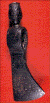
Loramie was a dearth pipe tomahawk. Arrowheads have been found in quantity along Loramie
Creek, the Greenville Treaty Line (Fort Loramie Swanders Road), the Dawson-Loramie Road
and along the Hardin-Wapakoneta Road in Turtle Creek Township.
'Indian' segment written in December, 1997 by David Lodge
[ Back to Indians Index ]
|