|
Pickawillany
Fort site is located in Piqua, Ohio
In 1747, the Shawnee in Ohio along with other Ohio tribes including the Delawares, Wyandots and Mingos were all
doing business with the new English traders from Pennsylvania. One such trader was an
Irishman named George Croghan. From his establishment of a trading post on the western
frontier of Pennsylvania in the 1740s, Croghan had sent out several traders as far west as
the Mississippi River. He traveled throughout Ohio and encouraged the Miami tribes to
attend annual meetings at his post in Logstown (on the Ohio River). Croghan’s
official reports and diaries have proved very useful in telling the story of the Ohio
natives during this time period.
Also in 1747, a detached band of Miami Indians from
Indiana under the leadership of their chief known as ‘La Demoiselle’ to the
French and ‘Old Britain’ to the English, (in an attempt to escape French
influence), set up camp near the confluence of Loramie Creek and the Great Miami River in
northern Miami County close to the southern Shelby County line. Beginning at this point in
time, this particular band of Miami Indians were often referred to as the ‘Tweightewee’ (Ancient maps indicate this spelling, which
is used throughout the Teacher’s Guide, however, various sources spell it in
different ways). Their camp, named Pickawillany, came to be known as an English trading
center after its leaders signed an agreement in 1748 at Lancaster, Pennsylvania, to trade
exclusively with the English.
Pickawillany prospered with the Miami Indians trading beaver, deer, bear, fox and
raccoon fur pelts (with beaver fetching the highest price). In exchange, the Indians could
choose from many items that included: stroud, duffel, half thicks, powder, lead, shirts,
coats, embossed flannel, callimango, wampum, vermillion, gartering, ribbon, pin heads,
rings, brass wire, handkerchiefs, knives and awl blades. Wampum was made by stringing
together shell beads of different colors, sizes and patterns. Wampum belts were made to
record important events with each string representing a different idea.
The French were very unhappy with the English encroachment into their
territory and their lucrative trade with the Indians. To reinforce French claim on the
area, they sent a force of 250 men under the command of Celeron de Bienville down the Ohio
River, planting lead plates at the mouth of each river entering the Ohio, including the
Great Miami River.
After which, he then proceeded north,
following the Great Miami River to Pickawillany. De Bienville and his men arrived on
September 13, 1749, and spent an entire week attempting to convince Chief La Demoiselle to
revert his allegiance from the English back to the French. De Bienville left Pickawillany
unsuccessful, as indicated in his journal, "All that I can say is that the tribes of
these localities are very badly disposed toward the French and entirely devoted to the
English. I do not know by what means they can be brought back."
The English,
realizing they needed to reinforce their presence in the area, obtained permission in 1750
from the Miami tribe to construct a stockade at Pickawillany for protection from attack.
George Croghan (Pennsylvania Indian Agent/trader) was instrumental in persuading La
Demoiselle to allow them to do so. Thus, Fort Pickawillany was born. The stockade was
built around the two-story main building with cabins for traders on the inside of the high
wall of split logs and some on the outside. Christopher Gist, Virginian, responsible for
picking good sites in the area for permanent English settlement, spent two weeks at the
fort and wrote an extensive journal. On his first day there he wrote, "This town is
located on the northwest side of the Big Miamee [Miami] River, about 150 miles from the
mouth thereof: it consists of about 400 families, and daily increasing; it is accounted
one of the strongest Indian towns upon this part of the continent."
During its short life, Fort Pickawillany saw much plundering of pack trains, murders,
and prisoners taken by those threatened by its existence. Finally, the French, after five
years of confrontation, sent a force of Ottawa and Ojibwa warriors, led by Chief Pontiac,
with French commanders from Detroit under the leadership of Charles Langdale with orders
to destroy it. The surprise attack came on June 21, 1752.
At the same time, Captain William Trent left the settlement of Logstown (20 miles west
of Pittsburgh) on the Ohio River, bearing gifts for the Tweightewee at Pickawillany. While
enroute, Trent learned of the attack and diverted his group down to Lower Shawnee Town at
the mouth of the Scioto River.
The following is a quote from Trent’s
journal dated 15 days after the attack. "Then Thomas Burney and Andrew McBryer, the
only two men that escaped when the Pick-town was attacked, came to us and told us that 240
French and Indians on the 21st of June about nine o’clock in the morning, surprised
the Indians in the cornfields, and that they came so suddenly on them that the white men,
who were in their houses, had the utmost difficulty to reach the Fort. Three, not being
able to get to the Fort, shut themselves up in one of the houses. At this time there were
but 20 men and boys in the Fort, including the white men.
The French and Indians having
taken possession of the white men’s houses, some of which were within 10 yards of the
Fort, they kept a smart fire on the Fort till the afternoon, and had taken the three men
who had shut themselves in one of the houses."
"The French and Indians, in the afternoon, let the Tweightewee know that if they
would deliver up the white men that were in the fort, they would break up the siege and go
home. After consultation, it was agreed by the Indians and whites that as there were so
few men, and no water in the Fort, it was better to deliver up the white men, with beaver
and wampum to the Indians not to hurt them, than for the Fort to be taken, and all to be
at their mercy. The white men delivered up accordingly, except Burney and McBryer, whom
the Indians hid. One of the white men that was wounded in the belly, as soon as they got
him they stabbed and scalped him and took out his heart and ate it."
Upon receiving the white men they delivered up all the Indian women they had prisoners,
and set off with the plunder they got out of the white men’s houses, amounting to
about 3,000 pounds. They killed one Englishman and took five prisoners; one Mingoe and one Shawnee killed, and three Tweightewee;
one of them the old Pianguisha king, called by the English ‘Old Britain’, who
for his attachment to the English they boiled and ate him all up."
There is almost no historical record of what
happened to the Tweightewee (Miami Indians) after the battle, except it is assumed that
most of them rejoined the main branch of the tribe in Indiana. A few of them may have
stayed in the area since there is a recorded battle with the Shawnee and others that took
place in 1763, however, a small group of them under the young Chief Muskeguanockque, and,
apparently, Old Turtle, Old Britain’s wife, and a son joined the Shawnee in Lower
Shawnee Town.
From Lower Shawnee Town, Trent and his 22 men, with other whites, boys and
Indians set out to investigate the Pickawillany battle. The Fort was still standing, with
two French flags flying, but it was deserted. After spending the night, and raising the
English flag, Trent and his entourage returned to Lower Shawnee Town.
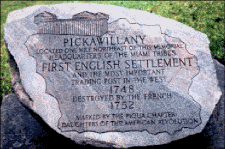
The Daughters of the
Revolution have installed a marker commemorating Fort Pickawillany on Hardin Road in
Piqua. After turning from State Route 66 north onto Hardin, it is within 1/4 mile on the
right-side of the road. The Johnston Farm house can be seen across the field, directly
behind the Pickawillany marker.
It is important to note that Piqua’s Indian history is also ‘our
history’ in that Shelby County, Ohio, was a
part of Miami County until Shelby County became a separate entity in 1819.
Piqua’s Indian Agent/trader, Colonel Johnston, in
particular, influenced Indian relations throughout the region.
Indians living on the western frontier believed that the area south of the Ohio River (Spay-lay-wi-theepi)
was holy ground. All tribes could hunt in the area now called Kentucky, but none could
live there. This made the area very attractive to white settlers and they soon began to
move across the mountains. The Shawnee did not want settlers in their hunting area, so
they often attacked the white towns.
'Indian' segment written in December, 1997 by David Lodge
[ Back to Indians Index ]
|