|
Feeding the Men and Horses
Such huge armies required equally
huge amounts of food and other provisions. It was commonplace for the men to go days with
little or no food. Dr. Wilson advised his Sidney, Ohio family in July of 1863 that "Presently
we are out of rations and obliged to wait for supplies." Sergeant Oldroyd of the
20th Ohio related a typical incident that occurred outside of Vicksburg one day. General Leggett approached their campfire and inquired whether or not the men had
food for supper. When he was advised they had none, he said, "Well, boys, I have
none either, and we shall probably have to fight for our breakfast." Oldroyd
replied: "Very well, general, I guess we can stand it as well as you."
One unforgettable type
of food was hardtack, a form of hard, dried cracker. The men had to break it over their
knees, or soak it overnight in order to eat it. When mixed with water, it was known as
'sluce'. As has 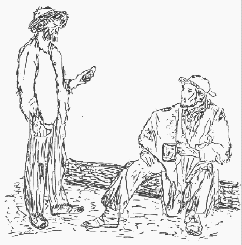 been the case throughout all of the wars, the folks back home heard a
different story. J. W. Morrow, chaplain for the 99th Ohio, sent a letter which the "Sidney
Journal" printed on June 3, 1863. It quoted Col. Swaine of the 99th as saying,
"A man could not be blamed for loving to soldier, when furnished with such a nice
camp, superb cooking arrangements and good boarding." been the case throughout all of the wars, the folks back home heard a
different story. J. W. Morrow, chaplain for the 99th Ohio, sent a letter which the "Sidney
Journal" printed on June 3, 1863. It quoted Col. Swaine of the 99th as saying,
"A man could not be blamed for loving to soldier, when furnished with such a nice
camp, superb cooking arrangements and good boarding."
The 118th Ohio, with a large
contingent of men from Shelby County, suffered terribly during the winters of 1862-1863
and 1863-1864. Lt. D. L. Crites provided this graphic description in a letter dated
November 29, 1863: "We are living entirely on corn sometimes ground, sometimes in
the ear or shelled and it is only through the greatest exertions that we can get that.
Hundreds of our men are becoming sick through fatigue and famine and unless the enemy is
soon driven from our front, we will have to retreat toward Chattanooga to get something to
keep soul and bodytogether. I have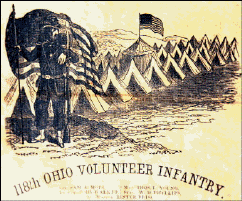 now seen the war in all its shapes, from enjoying the
calm sea breezes of a northern conscript camp to the mangled bodies of the dead upon the
battlefield together with the shock of contending armies, yet all is pleasant when
compared to the horrors of a starving army." now seen the war in all its shapes, from enjoying the
calm sea breezes of a northern conscript camp to the mangled bodies of the dead upon the
battlefield together with the shock of contending armies, yet all is pleasant when
compared to the horrors of a starving army."
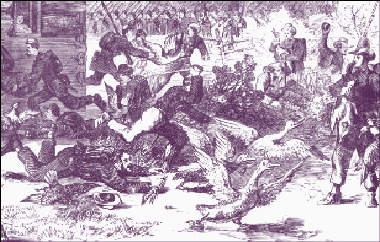
The armies inevitably resorted to
taking food from the surrounding countryside. This practice, considered theft by the
owners of the plantations and farms, was charitably referred to as 'foraging.' Pvt. Frank
Stockstill, a Sidney, Ohio resident who fought with the 118th Ohio, was often placed in
charge of a foraging detail. He and ten or so other soldiers foraged for several days at a
time, and returned with livestock, food, and often rebel prisoners. Cassius Wilson, a
brother of Dr. Albert Wilson, and a member of the 118th Ohio, related in a letter home to
his brother Henry in December, 1863, that "...being short of rations, Col. Young
told the boys to go for hogs or anything else good to eat." Union General William
Tecumseh Sherman made a telling observation about the effects of foraging on June 26,
1864: "We have devoured the land and our animals eat up the wheat and cornfields
close. All the people retire before us and the desolation is complete. To realize what war
is one should follow our tracks."
Dr. Albert Wilson expressed his disgust at the practice in a
letter home on February 5, 1863: "I sincerely wish there was better discipline in
our army as there has been so much vice and wanton destruction of property that I am
almost disgusted with it. If this course was likely to bring the war to a close any sooner
I might think differently...But the worst light in which it can be viewed is the probable
result on the morals of the young men. After they return from the service, they may not
give up so readily the vicious habits they have been accustomed to practice."
A private in the 20th Ohio wrote a Letter to the
Editor of the "Journal" on June 13, 1864, in which he reported the
reaction of one Southern lady he encountered while looking for food to the practice of
foraging: "This morning your nasty beast company (meaning cavalry) came
along and took nearly everything I had, and then your walking company (infantry)
came along and took the rest and burned my house!"
'Civil War'
segment written in July, 1998 by Rich Wallace
[ Back to Civil War Index ]
|