|
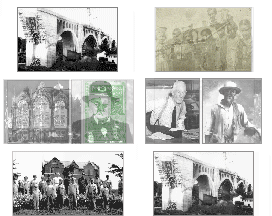
The Monumental Building
As the surviving veterans returned to their
families and began to piece together their lives, talk began about the manner in which to
memorialize the sacrifices of those who died and survived this nation's worst war. A.J.
Robertson of Sidney, Ohio was the first person in Ohio to originate the idea of
constructing a building that would both honor the past and serve the community.
Sidney
leaders were the first in Ohio to complete such a memorial hall. The Monumental Building was erected
with lottery funds and proceeds of bond sales by residents of the village of Sidney and
Clinton Township. Shelby County's many veterans were heavily involved in the planning and
fundraising for the massive structure. The cornerstone of the building was laid on June
24, 1875. The veterans chose colorful former California 'Forty-Niner' William Van Fossen, First Sergeant of
Company C of the 99th Ohio, to represent them at the ceremony. In dedicating the building,
he intoned: "Done in the memory of the fallen heroes of Shelby County, the state
of Ohio and the town of Sidney June 24th, in the year of our Lord, 1875."
The building was occupied by 1877, complete with an opera house on the
third floor. ‘Sgt. Baker,'
the statue facing east toward the courtsquare, was installed in December, 1900, after the
veterans passed a resolution seeking a statute to "inculcate lessons of patriotism
in the present and coming generations." The Monumental Building served as the
center of government and cultural life in the county for three-quarters of a century.
With the recently renovated first floor occupied by the Veterans Service
Commission, and plans underway for the Sidney Municipal Court to use the remainder of the
building, the most important Civil War memorial building in Ohio is experiencing a rebirth
as we head into the 21st century. Author John Fleischman, in an August, 1995 article
appearing in "Ohio Magazine," commented that our building is
"...renowned as Ohio's first veterans' hall...a gothic revival masterpiece." The author concluded: "Six or so major American wars later, Ohio's surviving
veterans' halls march toward the new century in ragged order. Some halls are all spit and
polish: others hang by a thread. As a sacred pledge to the honored dead, they represent a
standing reproach to the forgetful living."
'Civil War'
segment written in July, 1998 by Rich Wallace
[ Back to Civil War Index ]
|