|
Black Shelby Countians Serve Their Country
When news
reached Sidney that a recruiter would be in the area, Elias Artis, 30 years old
and married, and Hezekiah Stewart, 19 and single, joined the 54th Massachusetts Volunteer
Infantry and marched into history. Along the way, they were joined by five men from the
Mercer County black community of Carthagena. The 54th
enlisted only black soldiers, and with an officer corps that was all white, led by the
flamboyant Colonel Robert Gould Shaw, it was ready to prove to the Union Army its worth in
battle.
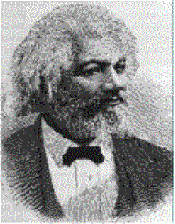
When the regiment sailed from Boston Harbor, Frederick Douglass, famed black abolitionist, was there
to wave good-bye and offer encouragement. On their arrival in Georgia, Shaw’s men
became discouraged with the lack of battle action. However, that changed on July 18, 1863,
when the regiment was chosen to spearhead a beach attack on Fort Wagner, a fortified
structure protecting the approach to the city of Charleston, South Carolina. The suicide
attack on Fort Wagner proved nothing but the bravery and valor of the 54th. When it was
over, nearly one-half of the 54th’s regiment of 600 volunteers had been killed,
wounded or captured. Many of them died that day, including Colonel Shaw who was buried on
the beachhead in a common grave along with his courageous black soldiers. Efforts to
return the Colonel’s body to Massachusetts were halted when his father insisted that
he remain with his men, saying, "We can imagine no holier place than that in which
he is...or wish him better company —what a bodyguard he has!"
Just before the battle, Sgt. Robert Simmons, one of Shaw’s men,
sensing the futility and danger in the Fort Wagner assault, wrote and mailed a message to
his family in New York City, "God bless you all! Good-bye!" One of the
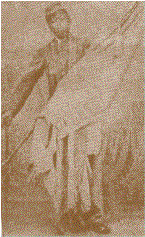
survivors, Sgt. William Carney, despite multiple wounds, carried the regimental colors
that day, and yelled, "The old flag never touched the ground, boys!" For his
bravery, Carney became the first of twenty-three blacks to win the Medal of Honor.
|
|
Frederick Douglass |
Sgt. William Carney |
One of the Carthaginian men died, Elias
Artis was wounded and hospitalized, while Hezekiah Stewart remained unscathed to fight on
with the 54th, and the Union Army as they moved around the unchallenged Fort Wagner, and
on to the glorious conclusion of the war. Frederick Douglass,
in a proud moment of praise and a powerful appeal for the greatest gift his brothers could
receive, said, "Once let the black man get upon his person the brass letters,
U.S., let him get an eagle on his button, and a musket on his shoulder, and there is no
power on earth which can deny that he has earned the right to citizenship in the United
States."
The "New York Tribune" in
its summation of the Battle for Fort Wagner, reported, "It is not too much to say
that if this Massachusetts 54th had faltered when its trial came two hundred thousand
troops for whom it was the pioneer would never have been put into the field...But it did
not falter. It made Fort Wagner such a name for the colored race as Bunker Hill has been
for 90 years to the white Yankees." The courage of the 54th and their now
recognized commitment to patriotism, became a rallying point for 200,000 freed blacks who
volunteered to fight on behalf of the North. Their presence on the battlefield, fighting
and dying, gave impetus to the fight to eliminate slavery forever and guarantee the
preservation of the Union.
A notice that appeared in "The Sidney Journal", May
20, 1864, encouraging Shelby County colored citizens to enlist in the 5th U.S. Colored
Troops appealed to their patriotism, and support of the government. All soldiers now
received equal pay. Sidney or Shelby County has no record that Elias Artis or
Hezekiah Stewart ever returned to their homes in Ohio, or that their war service bonus of
$325 per man was ever paid.
Somewhere in this country, they may have young descendants who do
not know what Shelby Countians know about their ancestors. Residents can see the names of
all 325 Civil War dead cut in the polished marble of the Civil War Tablets housed on the
ground floor of downtown Sidney’s Monumental Building. Constructed
to honor its war heroes, the tablets were originally installed on the second floor of the
structure.
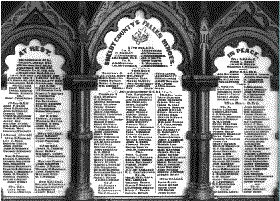
If Artis and Stewart had returned to
Shelby County, along with other Civil War veterans, however,
their reception may have been less than civil in an environment charged with racism that
threatened the welfare of new Negro residents if they did not relocate outside Shelby
County.
The warning to move was issued by the I.O.O.N.A.
Research efforts have been unable to determine an interpretation for
"I.O.O.N.A." and who they represented. [Conjecture has it, that it could have
been a temporary acronym for - International Order Of Native (or North) Americans]
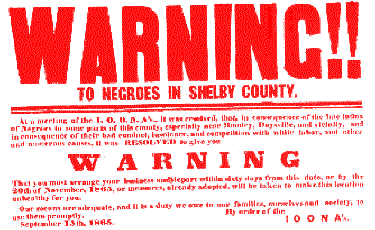
'Black History' segment
written in June, 1998 by David Lodge
[ Back to Black History Index ]
|