| There are but a few tragic events in each
generation that sweep across differences of culture and time, drawing everyone together in
a ritual sense of mourning. The recent death of John F. Kennedy, Jr. and the tragic ending
Princess Dianna of England met had that type of effect on millions of people. Young
people, flush with idealism and promise. Death seemed so senseless. Perhaps the effect of
such an event in a smaller community is even more compelling. The citizens of Sidney woke
up one Sunday morning over 75 years ago to the news of a tragedy that shook the town to
its core. It involved one of the brightest and best young people Sidney had ever produced.
Her name was Winnifred Haslup Gearhart. This is her story.
She enjoyed a storybook
childhood in the William Haslup
home on North Street, with her older sister Maude and brother Leigh. Her father was an
industrialist, and their home, modeled after Washington's Mount Vernon home on the first
floor, was one of the nicest residences in the city.
She married Dr. Clyde Gearhart, a prominent dentist, and the couple settled in nearby
Greenville. Greener pastures beckoned, and they moved to Washington, D.C., where Dr.
Gearhart became nationally recognized as an expert on pyorrhea. He was president of the
American Academy of Periodontia, and lectured extensively at Georgetown University and
across the country. Winnifred made it a habit to visit the disabled soldiers of the
World's War at Walter Reed Hospital in Washington. She developed a reputation as a
whistler, and would entertain the boys with her whistling.
Winnifred spent the week of January 18, 1922, with her family in Sidney while Clyde
attended to business in Chicago. They returned to Washington together, concluding what
would be her last family visit. Washington's Knickerbocker Theatre was the site of a
comedy performance on Saturday night, January 30. The Gearharts, prominent socialites in
Washington circles, attended. Heavy snow was falling as those attending entered the
theater.
A survivor inside later recalled, at the beginning of the second act, "...a great
fissure running across the ceiling. The plaster began falling..." The entire ceiling
collapsed on the balcony, which in turn fell to the floor below. Florida Congressman John
Smithwick was there that night. He described what happened next: "The noise was
awful....It was simply indescribable....In the midst of the roaring were shrieks and cries
of women and children and a few shouts of men. There were cries of help, groans and worst
of all, the moans of those in terrible pain." Scores were killed. Clyde
Gearhart lay under the rubble, pinned across the legs by a steel beam. He never lost
consciousness in the darkness as the cold settled in. Beside him lay motionless Winnifred.
She had been killed instantly by a huge block of concrete. Accompanied by the moans of
those around him and the noise of the frantic rescue efforts above him, Clyde laid beside
his wife for 7 long hours.
The news of Winnifred's death did not reach Sidney until about 9 am Sunday, the next
day. The Monday edition of the Sidney Daily News captured the reaction of this community.
"The citizens of Sidney suffered a terrible shock Sunday morning when the news was
flashed from Washington that Mrs. Winnifred Haslup Gearhart had been killed...The news
spread throughout the city like wildfire and many were the expressions of sorrow and
regret heard on every hand...Seldom has a calamity so stirred the people of Sidney."
The pain felt by so many was shared by those
around the country. All social activities were canceled in Washington. Messages of
condolences poured in from the President of the United States and many foreign countries
to the families who lost loved ones.
The Methodist Church on Poplar Street
was filed to capacity for the funeral that followed. The Reverend Roberts handled the
service, and reminded those assembled that no one should deny their faith in this time of
senseless loss. "Winnifred was child of the Christian faith. To deny the faith would
be to deny her life." In describing the relationship Winnifred had with her many
friends, Rev. Roberts commented "We all recognize that this one you loved so dearly
was a daughter of the whole community, a sister to every acquaintance and a friend to
every heart hungry for human sympathy."
The heartbroken Clyde Gearhart carried physical scars as well. He had one leg amputated
above the knee, and sustained crush injuries to the other leg. Although not a native of
Sidney, he did not forget the bond between Winnifred and her beloved Sidney. He made
provisions for a special gift that would live on in her memory.
Another special service at the Methodist Church was scheduled for 4 PM. on November 5,
1922. People arrived as early as 2 PM, and by the appointed hour, hundreds had been turned
away because the sanctuary was full. Dr. Gearhart had purchased chimes for the church, and
the purpose of the service was to dedicate them as an eternal reminder of Winnifred. In
accepting them, Rev. Roberts observed: "As the years come and go, and we gather in
this sacred temple from time to time and listen to the music of these chimes, our memories
will respond, and your thoughts and our thoughts will be of her, and as a result, she will
continue to live with us, the same ideal character we have always known her to be..."
The Sunday morning chimes to this day tell of the worship services within, and also
celebrate the life of Winnifred Haslup Gearhart.
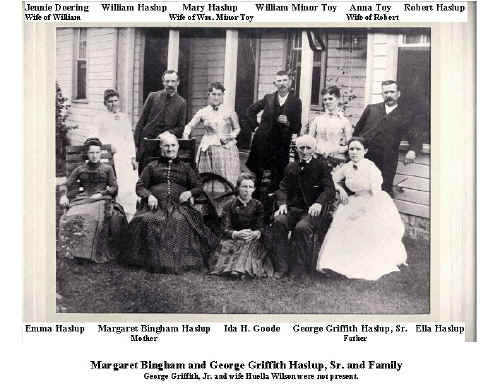
Photo of Haslup family courtesy of Jack and Kathleen Haslup.
[ Back to Women Index ] |