| Many Ohioans, especially the residents of
Cincinnati, were recently reminded of the power of Mother Nature by the surging Ohio River
and the swath of destruction that was created in its wake. Newspapers in the Queen City
carried stories about the great floods of the past,
including the devastating flood of 1937. Disasters invariably create opportunities for
some. Such was the case for a young college graduate from Shelby County. As a result of
her work with the Army Corps of Engineers, principally in the area of flood control, she
gained an opportunity to become the first licensed and practicing woman architect in Ohio.
This is her story.
Ninety years ago this summer,
a little girl was born to Calvin and Ethel Boyer. They gave her the beautiful name of
India - after India Schoaff, a good friend of the family. The Boyers raised their family
in Perry Township. Ethel Boyer was destined to be a pioneer of sorts herself. She served
as the first woman on the Perry Township Board of Education for over a decade, beginning
in 1930.
India's two brothers, Ralph and Howard, both chose traditional male professions and
were successful. Ralph graduated from The Ohio State University with a degree in
electrical and mechanical engineering. He subsequently became vice-president of The Cooper
Bessemer Corporation. Howard chose metallurgy as his major at Ohio State. During the
summer following his first year in college, he lost his leg in a farming accident. Howard
did not return to college, but studied on his own, and ultimately became chief
metallurgist for American Bosch Corporation in Springfield, Massachusetts.
With encouragement from her parents, and wonderful role models in her brothers, India
set her sights on a career in architecture. After graduating as class valedictorian from
Pemberton High School in 1925, she also selected Ohio State. India recalls that "I
felt I was not quite ready for college at 18, so I chose to work in the office at the Sidney Machine Tool Company. I made $10 a
week." She began classes a year later in the fall of 1926.
The university had just opened the Department of Architecture to women, and six
enrolled. To her surprise, India found that military training was required. She refused to
participate. "I saw no point in spending my time marching on the field with the
male students. In my senior year, the requirement was eliminated! " The rigorous
academic workload also eliminated the other female students. By the beginning of her
second year, only she remained.
India found the work difficult, and the reception from the male students cool at first.
The university was also adjusting to the reality of its first female architecture student.
On one occasion, she learned that a competitive examination was scheduled among the
students. The winner would be invited to study architecture in France during the summer.
India later recalled: "When I learned that I would not be eligible to take the
exam, I became very upset and protested my exclusion. I was told that I could not be
included in the competition because I might win and there were no facilities for women
there."
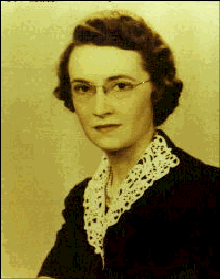
India Boyer
The longer she stuck it out, the more respect
she earned. Toward the end of her tenure at Ohio State, the students had to compete in an
all-day design project. She struggled alone to understand what the professor was
expecting. Suddenly, two senior male students appeared by her side. To her relief, they
helped her conclude the project.
Between her junior and senior years, she worked in the
summer for Joseph Bradford, the architect for the university. India's dream was to
continue to work for the university and him after graduation.
The spring of 1930 finally arrived. 1,450 students qualified for graduation. Only 11
received degrees in architecture. India was the only woman. It was with a great
amount of pride that she accepted her diploma. Her plans of working for Joseph Bradford
never materialized. TheGreat Depression was upon the country and there was no opportunity
at Ohio State. Business conditions also ruled out her plan to pursue a graduate degree at
Columbia University in New York City. It was back to the family home in Perry Township for
India Boyer.
Her task was a daunting one. Not only was there little or no work during the
depression, but she was trying to gain a foothold in a profession where there were no
other women. India searched for work with Shelby County builders and found little. She
struggled here for four years, and finally gave up. After taking an examination for a
position with the U. S. Army Corps of Engineers, she was given a six month temporary
appointment there. India was cautiously optimistic.
It turned out to be the chance she needed.
She was offered and accepted a permanent job working on navigation and flood control
projects. It was with the latter that she made her mark. "I found it much more
challenging," she remembered. "After the great flood of 1937, everyone
wanted protection from the ravages of Mother Nature. I traveled throughout the tri-state
area inspecting not only flood control projects, but other engineering projects as
well."
India also vividly recalls some of the political controversies that
arose over the flood control measures that were instituted. "People were opposed
to levies along the river. They also did not like my idea of removing the bridges across
the Little Miami River." She was determined to do what Cincinnatians needed. She
supervised, among other projects, the construction of the Beachmont levy in Cincinnati.
India Boyer was appointed head of the architecture department of the Corps in 1939, and
held the position for seven years.
She never lost sight of her original goal to work as an architect in private practice.
India Boyer made history in 1941 when she became the first female in Ohio to sit for and
pass the state architecture examination. After four more years with the Corps of
Engineers, she was ready for private practice. She resigned her position, and along with
several co-workers, founded the firm of Vogt, Ivers and Associates in the Queen City.
India became director of the firm's architectural division, and assumed responsibility
for the contract drawings and specifications for commercial, industrial, educational and
religious facilities. This work brought her into contact and competition with an all-male
profession in the private arena. She relished the challenge. "It was dominated by
men. I had to get used to that. Men didn't hire women." The only female employees
with whom India worked during her career were drafters.
India Boyer can look back on a long list of successful ventures in the Cincinnati area.
In the 1950's, Ryerson Steel Company was a large employer in the city. Boyer designed the
entire architectural layout for the buildings and rail systems of the Ryerson complex and
all its branch offices. She remembers working on the original WCPO -TV studios in
Cincinnati as well as portions of the King's Island complex.
Other buildings on which India Boyer worked, well known to Cincinnatians today, include
the Provident Bank and the Federal Building. India Boyer's interests in design spanned
from commercial to industrial to recreational and educational as well. She designed the
Elmwood Place School and the Shawnee Park. A heart attack in 1975 forced her into
retirement. However, she continued to serve as a consultant for the Hamilton County Park
District, Place School and the Shawnee Park. A heart attack in 1975 forced her into
retirement. However, she continued to serve as a consultant for the Hamilton County Park
District.
After her retirement, she took up watercolors as a hobby. Her sense of artistry and the
habit she had developed as an architect concerning attention to detail served her well.
Her paintings soon were the subject of local exhibitions.
Her pioneering efforts have been
recognized throughout the state since she left the active practice of architecture.
Several local leadership awards were presented to her. India Boyer was designated as one
of the YWCA Women of Achievement in 1982. The next year, she received the Outstanding
Alumnus Award from The Ohio State University.
Perhaps the highlight for her occurred in
1994. A group of women architects established the India Boyer Guild of Women in
Architecture. As the founders of the group gathered to pay tribute to the Shelby County
native, there was much talk about what a significant role India had played in creating
opportunities for women in her profession. "She is a pioneer," Betsy
Moore, one of the founders stated. "Even today in the large firms that may have 30
or 40 architects, there are only one or two women. It's a field that is still dominated by
men. You can imagine what it was like 50 years ago."
India Boyer was modest in her response. "I just thought of myself as an
individual doing what I had to do, " she recalled. As she approaches her 90th
birthday, India Boyer recently reflected on her life. "Looking back, I am reminded
that my career presented many challenges and often took precedence over my personal life.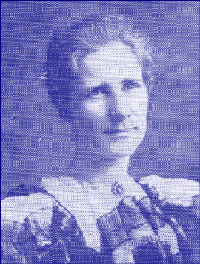 However, along with the challenges, came many rewards and much fulfillment." She
resides in the Mt. Washington suburb of Cincinnati. However, along with the challenges, came many rewards and much fulfillment." She
resides in the Mt. Washington suburb of Cincinnati.
POSTSCRIPT: Ida Boyer passed away at the age of 90 on Monday, February
9, 1998, at the Hospice of Cincinnati in Blue Ash. (As reported in The Sidney Daily
News, 2/12/1998, Pg. 2A.)
Another successful woman,
from the turn-of-the century, was Mrs. Delia
Amos (at right) who worked at Sidney’s local newspaper, The Daily Newspaper, from
its opening in 1905. She traveled extensively in this country, Mexico, Europe, Egypt and
the Holy Land. Mrs. Amos also served as President of the Ohio Women’s Press
Association.
[ Back to Women Index ] |