| Peter
Loramie, the relatively obscure backwoods Indian trader of the late 1700’s in what is now known as Shelby County, is better known in
Cape Girardeau, Missouri, as Don Louis Lorimier, diplomat, military officer, and
government official, according to Loramie/Lorimier expert and Missouri resident Linda Nash
Loramie, or Lorimier, worked for
three different governments in his lifetime —French, Spanish and American, Nash said.
"He played a significant supporting role in a very dynamic period of history."
While commanding Spanish forces in the Cape Girardeau area, Loramie met with Meriwether
Lewis at the start of the Lewis and Clark Expedition.
Nash, a 25-year teaching veteran from Jackson, Missouri, spoke July 16, 1998, to more
than 110 members of the Shelby County Historical Society and the Fort Loramie Historical
Association.
Loramie came from a French military family, but earned very little as an army officer,
according to Nash. He earned extra money by moonlighting as an Indian trader, first
setting up shop near present-day Fort Loramie in 1769. It was called the Frenchman’s
store. "He became a good hater of Americans," Nash said, "Because
the Americans were pressuring the Indians westward, threatening his livelihood."
There is no truth to the rumor that Loramie was a Jesuit priest, Nash reported. He had
three wives and the Jesuit order has no priesthood record of the name.
Loramie, burned out of his local trading post in 1782 by General George Rogers Clark, lost
up to $70,000 worth of trade goods such as silver, cloth, blankets, brass kettles, bells,
ribbons and vermilion. "Remember, that is in 1782 dollars. It would be a lot more
than that in curren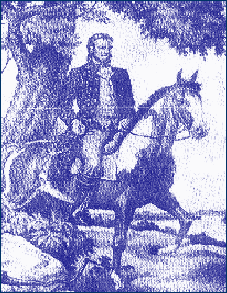 t dollars," Nash cautioned. t dollars," Nash cautioned.
After five years engaged in the Wabash Valley fur trade, Loramie finally settled
in the Cape Girardeau area and worked for the Spanish as an Indian agent charged with
resolving differences between the Spanish and the Indians. He also headed the Indian
militia, helping Spain defend the Louisiana territory against the encroaching Americans.
He was valuable to the Spanish, and later the Americans, because he spoke 22 Indian
languages and was thus able to translate between the Indians and the settlers. "He
became an able advocate for the Indians and was very fair in dealing with both
sides," Nash said.
Lorimier was well rewarded for his service, receiving more than 30,000 acres of land
from the Spanish, according to Nash. He was also given the Spanish title of
"Don" and served as commandant of the Cape Girardeau area. The 1940’s painting
(shown at right) of Lorimier by a Missouri artist shows a sophisticated figure in sharp contrast to
Loramie’s local rough-cut image.
Following Spain's cession of the area to France and the later Louisiana Purchase,
Lorimier finally worked for the Americans, becoming U.S. Indian agent in 1806. "He
was respected by the Indians for honesty and integrity," Nash said, indicating that
Lorimier spent 43 years of his life representing the Indians in some capacity. He died in
Cape Girardeau in 1812 after a long bout with tuberculosis and malaria.
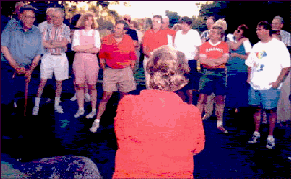
Those who attended the July 16, 1998, meeting
on Peter Loramie were treated to a tour of the Ferd Fleckenstein Farm,
location of the
original trading post. Ferd is shown at the far left in the blue shirt.
Photo courtesy of
Tom Homan.
About Linda Nash
One of the earliest Europeans to enter our locale
and one who prominently left his name on several of our landmarks—Peter
Loramie— was featured at a joint Shelby County Historical Society/Fort Loramie
Historical Society meeting on July 16, 1998.
Linda Nash of Cape Girardo, Missouri, portrays one of Loramie’s three wives as a
living history character. Nash has 25 years of experience teaching history in Missouri
schools. Loramie lived in Cape Girardo after leaving the area that later become Shelby
County. He is buried there.
Nash traced the life of this famous character and concentrated on his life in Shelby
County as the founder and proprietor of Loramie’s Trading Post which he established
in 1769. After the Americans burned his trading post, Loramie moved west and eventually
resided in the Cape Girardo area where he served as commandant of the Spanish district.
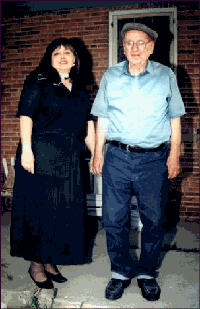
Linda Nash is pictured
here with Ferd Fleckenstein, whose farm is the site of the original Loramie trading post.
This is one of the last photos of Ferd, who passed away within a few weeks of this
historical program.
Photo by Tom Homan.
[ Back to People Index ] |