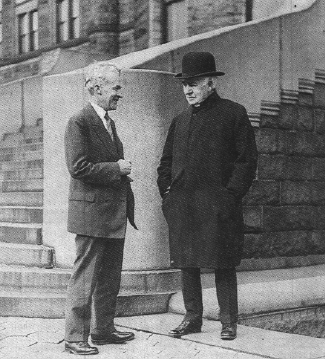
Clyde
Fisher visited with Thomas Edison during a visit to the Hayden Planetarium. Fisher
helped create the museum with the assistance of New York banker Charles Hayden.
For centuries,
human beings have gazed up to the stars, wondering what secrets lay locked away in the
distance. From many generations before the Greeks to the present day, mankind has sought
more knowledge to help explain the mysteries above. Sidney, Ohio made its own
contribution to the ongoing study of our last frontier. An inquisitive, young Shelby
County man did more than any other American to make the heavens understandable to all.
This is his story.
Our country's foray into astronomy began with the opening of the Hayden Planetarium in
September 1935. It was a proud day for Dr. Clyde Fisher, the curator of the planetarium.
He had come a long way.
Clyde Fisher was born May 22, 1878, on a farm along county road 25A in Orange Township.
At the 1892 Orange Township school commencement exercises for the 9th grade, young Clyde
gave the valedictory oration on the topic: "Examples of Great Men." It was to be
a good omen for the young student. After graduating from the Sidney schools, he taught
school for a period of time, and then furthered his education at Ohio Northern University.
He transferred to Miami University in Oxford, graduating in 1905. While a student at
Miami, his extraordinary intellect and natural curiosity allowed him to master the fields
of geology and zoology, as well as astronomy.
He taught school in Troy for two years, where he was one of the first teachers to
introduce geological projects into a curriculum that centered mostly on the three 'Rs.'
Clyde Fisher subsequently moved to Florida, where he was a professor at DeFuniak College
and taught ornithology at the University of Florida. He thirsted for additional knowledge,
and returned to post-graduate studies at John Hopkins University in Baltimore, Maryland,
to study botany, obtaining his Ph. D. in 1913.
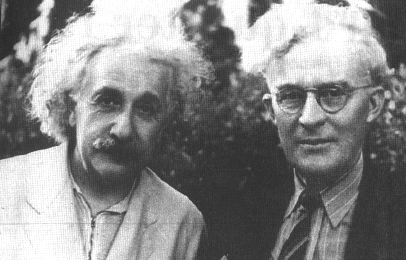
Clyde
Fisher is shown here with Albert Einstein. The two scientists are believed to have
met in Germany.
The reigning American botanist during the first
quarter of the 20th century was John Burroughs. Fisher went to visit him when Fisher was a
young man, and they developed a close friendship. Mr. Burroughs numbered among his good
friends Theodore Roosevelt, the poet Walt Whitman, and the greatest naturalist of the
American west, John Muir. That was this kind of company that Clyde Fisher kept on his many
visits to see Mr. Borroughs at his home in upstate New York.
"When he first entered the service the telegraphic messages were received by tape
form in code and they were translated and delivered to trainmen and others receiving
messages.
"The engines were the wood burners and employees and trainmen would reload with
wood and fill the tanks with water at various places enroute along the line.
"The old watering pond, some miles south of Botkins, played a very important part at
that time, and a storage of wood for engines was nearby."
Fisher's versatility as a scientist resulted in an appointment to a staff position with
the American Museum of Natural History in 1913. As a June 1940 article in the periodical Natural
History pointed out, Fisher became the 'jack of all trades'. Over the next decade, he
created courses of study for students and teachers in every discipline covered by the
museum. His contributions to the emerging field of teaching science to young children were
ground-breaking and nationally recognized.
Dr. Fisher was given the task at the museum
of creating a department on astrology in 1924. The study of astronomy was actually an
early and life-long interest. When he was growing up on the farm in Orange Township,
Clyde's two uncles, both of whom were amateur astronomers, had him gazing through a
telescope at an early age. He was hooked.
With his knack for making the most difficult
subjects understandable to young minds, Dr. Fisher sought ways to make his new department
child-friendly. German scientists were experimenting with an idea called a 'planetarium',
where the wonders of the night sky are projected on the inside ceiling of a building. With
no planetariums in this country, and little in the way of professional equipment, he
traveled to the Carl Zeiss Optical Works in Munich, Germany. The Germans had constructed
an instrument that was capable of projecting over 9,000 stars along with the sun and moon,
all of which moved across the domed ceiling in proper relation to each other. He never
forgot his first experience with the planetarium. "An involuntary 'Ah' swept over the
assembly," he recalled. "In short, I was astonished, overwhelmed. The illusion
of the immensity of space is perfect. It is the greatest invention ever devised by man as
a visual aid in teaching."
Excited, he hurried back to New York with plans for America's first planetarium. The
Great Depression intervened. That fact, along with other budget constraints at the museum,
shelved his project for ten long years. With a government loan and a bequest from the
estate of New York banker Charles Hayden, the $850,000 Hayden Planetarium project was
completed in 1935.
Clyde Fisher was far from a dry, boring scientist. With his teaching background in
Ohio, and his work with New York City's children, he was able to make the planets and
stars come alive. He once said "You can't make people interested in the stars if you
don't make it any more interesting than math or physics." He always thought that if
children understood and enjoyed astronomy, then surely adults would as well. Adults
certainly did. Fisher was a world-renowned lecturer on astronomy and other subjects.He
reveled in pointing out the fascinating facts about our solar system. When a columnist
from the New York Sun inquired of him in an interview how he seemed to move so fast
in all directions with his various projects, Fisher reminded him what a ride the columnist
was on, going between 600 and 700 miles an hour just seated in his chair, based on the
rotation of the earth.
Clyde Fisher really did move quickly in all directions. The September 1947 edition of
the Miami Alumnus called him 'the most versatile living natural historian.' At that
point, two years prior to his death, he had been a teacher, college president,
photographer, botanist, ornithologist, geologist, mammalogist, paleontologist, and
astronomer. The Alumnus article stated that "His relentless intellect led him
into one, then another field of natural science....author, world traveler, explorer,
lecturer-these are a few of the titles which describe him."
His fascination with life propelled him outside the
textbook and classroom. With his grounding in the natural sciences, he was invited to
participate in many early expeditions to remote parts of the world, including Lapland and
Bermuda in the early 1920's. Dr. Fisher led expeditions to Siberia and the mountains of
Peru to view eclipses in the early 1930's, and again in 1936 and 1937. He also went to
Mexico to study an active volcano for parts of two years beginning in 1943. An avid
photographer, he made the first photographs of an eclipse of the sun from above the
clouds.
Between his many trips, Fisher continually
improved the Hayden Planetarium. By the end of his career, it had evolved into two
chambers. The upper one contained a hemispherical dome 75 feet in diameter on which was
projected all of the stars one could see with the naked eye. The lower one was known as a
Copernican chamber. The earth and all the planets were projected on the dome, all moving
in the proper rotation in their relation to the sun. It was immensely popular.
The
exploits of Sidney's famous son were occasionally chronicled in the Sidney Daily
News. The April 16, 1928, edition noted with pride his trip from New York to Chicago
and Milwaukee to lecture on "Camping with the Indians." Dr. Fisher stopped in Sidney
on his way home, and agreed to present his lecture at the high school. The article
concluded: "No one who knew Dr. Fisher in his boyhood will miss hearing him..."
A companionship with one of America's great nature writers, Ernest Thompson Seton,
resulted in several trips out west for Dr. Fisher, including one to the Indian territory
of the Sioux. While there to study Indian sign language, Seton and he were adopted into
the Sioux tribe. The mild-mannered Fisher was named 'Afraid-of-Bear", the name of one
of the braves who killed the great Sioux leader Sitting Bull. His life would intertwine
forever with Indian culture soon thereafter. Te Ata was a full-blooded Chickasaw Indian
Princess 17 years his junior. A respected expert on Indian lore, her participation in the
Chautauqua concert circuit took her from her native state of Oklahoma around the country
and eventually to New York City. The two met while participating in a panel discussion.
The once-divorced Clyde Fisher and the princess fell in love and were married in 1933.
Te Ata became the most recognized spokeswoman for Indian lore and culture in America.
Her name in English meant 'Bearer in the Morning.' Te Ata had the same enigmatic charm of
her husband. A publicity brochure of the time noted: "With pride in her race, Te Ata
expresses the Indian character with such sympathy...that with a change in her voice...she
becomes a warrior, an old man, a young maiden, a new mother..." She performed for
President FrankLin Roosevelt's first state dinner in the White House. Te Ata was also
chosen to represent the American Indians in the program she presented to King George VI
and Queen Elizabeth.
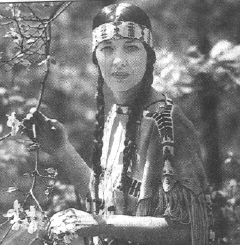
Clyde Fisher's wife, Princess Te Ata
Clyde Fisher and Princess Te Ata continued to
excel in their very different worlds for many years. Fisher concentrated on making
astronomy visually stimulating and learnable for children of all ages. In a biographical
article entitled "He Brought Stars To America," D. R. Barton concluded that
Clyde Fisher was "Internationally famous as a great teacher and a pioneer in the
broad field of visual instruction." He also maximized the opportunities of others to
share his love of his favorite field by forming the national Amateur Astronomer's
Association and the museum's Junior Astronomy Club.
Only eight years after his
retirement as Director Emeritus of the Hayden Planetarium in 1941, Clyde Fisher passed
away in New York City. He is still acknowledged as the 'father of astronomy' in this
country. The Daily News article announcing his visit here in 1928 summed up the feelings
of a proud home town: "He is the son of this community of whom we are all justly very
proud. His accomplishments tower high before the world."
Dr. Fisher's living relatives in Shelby County, Ohio include nephew Jim Lewis, great
nieces Kay Baker and Charisse Brining, and great nephew Craig Lewis.
[ Back to People Index ] |