Crossing Beringia
Although experts disagree on the earliest settlement of immigrants in North America, it is
universally conceded that Paleolithic humans crossed the "land-bridge", (known
as Beringia), caused by a drop in the water level of t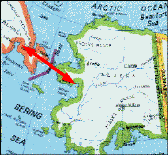 he Bering Sea, at the Bering Strait
either prior to the first Wisconsin stage of the ice age (70,000 - 50,000 BC) or the
second stage (50,000 - 40,000 BC). Sea levels fell as much as 500 feet due to the
impounding of water by the forming ice. Conversely, when the ice melted, the sea levels
rose and Beringia submerged. While it may be difficult to comprehend immigrants arriving
here as early as 70,000 BC, the theory becomes credible when placed in the context that
Paleolithic and pre-Paleolithic artifacts have been unearthed on other continents that
date back to 750,000 B.C.
he Bering Sea, at the Bering Strait
either prior to the first Wisconsin stage of the ice age (70,000 - 50,000 BC) or the
second stage (50,000 - 40,000 BC). Sea levels fell as much as 500 feet due to the
impounding of water by the forming ice. Conversely, when the ice melted, the sea levels
rose and Beringia submerged. While it may be difficult to comprehend immigrants arriving
here as early as 70,000 BC, the theory becomes credible when placed in the context that
Paleolithic and pre-Paleolithic artifacts have been unearthed on other continents that
date back to 750,000 B.C.
After crossing Beringia, these prehistoric Indians (called prehistoric because they
pre-date written history) or ‘Amerinds’ settled in Alaska and northwestern
Canada. Eventually they migrated south following the forming of an "ice-free
corridor" that allowed them to move through Alberta and Saskatchewan. In time, this
route disappeared when the two great ice sheets merged around 20,000 - 15,000 BC.
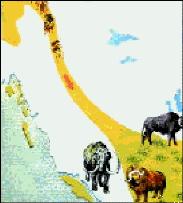
Coastal routes were also used to reach the temperate climate, lush forests, mountains,
rivers and valleys of the northwestern United States. From there, it was on to the even
warmer temperatures of the southern states, Central and South America. About 15,000 BC,
the glaciers began to melt, and by 10,000 BC were retreating dramatically causing the
"ice-free corridor" to reappear and widen. By 9,000 BC the ice covered only the
areas that are currently ice-bound today. This was important to migrating populations because without these geological
developments, they could not have reached North America
ANOTHER
PERSPECTIVE
""There
is a commonly held belief that thousands of years ago, as the world today counts time,
Mongolian nomads crossed a land bridge to enter the western hemisphere, and became the
people now known as the American Indians. The truth, of course, is that the Raven found
our forefathers in a clamshell on the beach at Naikun. At his bidding, they entered a
world peopled by birds, beasts, and creatures of great power...At least, that’s a
little bit of the truth."
Bill Reid, Haida
Tribe