|
100 Years Ago
Agriculture
Black History
Canal
Civil War
Downtown
Education
Entertainment
Events
Gold Rush
Immigration
Indians
Industry
Landmarks
Law and Order
Organizations
People
Pioneers
Politics
Sports
Transportation
War
Women
|
 |
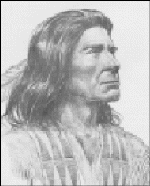
Blue Jacket
Blue Jacket was born around 1745, but it is not known where
as there is no record of him until around the 1790s. His Indian name was Weyapiersenwah,
although there is conjecture by many historians that he was actually Marmaduke Van
Swerangen, a Virginia white boy captured by the Shawnee during the Revolutionary War. The Indians were so impressed with his
skills they eventually made him a chief. There is no conclusive evidence to support this
contention, however, and because almost nothing is known, his origin may always be open
for discussion. It is not known where he was born or exactly when, and what he did for
almost the first fifty years of his life. |
Blue Jacket |
| It is known that he was active under Little Turtle in the fight against American expansionism
after the end of the Revolutionary War, including Little Turtles unsuccessful
assault on Ft. Recovery on June 30-July 1. 1794. He was
undoubtedly at Harmars defeat (1790) and St. Clairs
Shame (1791). When General Wayne was sent by President
Washington to resolve the Indian uprising, Wayne took two years to train his army before
committing them to battle. Little Turtle was obviously impressed, and began to support
peace in the region. His followers branded him a coward and chose Blue Jacket to lead them
in the Battle of Fallen Timbers (August 20, 1794). The
Indian defeat ended in the signing of the Treaty of Greene
Ville where Blue Jacket was a signatory. He also signed the Treaty of Fort Industry
(American fort built by General Wayne in 1794 on the present day site of Toledo) in 1805,
after which, he disappeared from historical records forever.
Historian Hill recounts the
memoirs of Thomas Morrow (born 1804) in an article in the November 24, 1966, edition of
the "Piqua Daily." Morrow talks about his childhood years in the Piqua area and
the school he attended that was located in Colonel John
Johnstons cemetery. Hill sights an unknown source that indicated that one of the
schools scholars at that time was George Blue Jacket, son of the Shawnee Chief Blue
Jacket.
'Indian' segment written in December, 1997 by David Lodge
[ Back to Indians Index ]
|
|
|