|
Industry and Transportation are Key to Success
Sidney, Ohio,
profited handsomely from road construction with local industrialist Benjamin Slusser of Slusser-McLean inventing the first steel
drag road scraper. (A McLean scraper is shown below). There would eventually be
four street scraper manufacturers located here, including the American Steel Scraper
Company whose profits helped W.H.C. Goode finance the constructio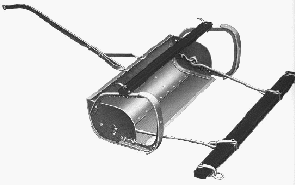 n of Whitby Place [GreatStone Castle]. n of Whitby Place [GreatStone Castle].
In many cases, the early bricks are still there on streets such as South
Ohio Avenue, lying six to eight inches below a black top surface. Black top roads were put
down throughout the county in the 1930s. Sidewalks were also made from a variety of
materials including gravel. Property owners were responsible for the maintenance of their
own sidewalks.
Ohio, being
mostly flat and dotted with cities, had been a natural home to the ‘trolley’ or
interurban. It was here, in 1889, that the industry was born, when the first seven-mile
line linked Newark and Granville. This was the way to travel to a picnic, a dance, the
fair, etc.
Clean and efficient, the trolley lines
operated local cars that stopped at every town. By 1916, Ohio had 2,798 miles of line,
one-sixth of the nation’s total, with lines connecting every place in the state that
could count 10,000 inhabitants.
In 1907, a Cincinnati-to-Toledo ticket cost $3.25 on the New York Central
Railroad but only a $1.75 on Lake Shore Electric. Lines ran everywhere, but Dayton ranked
second nationally only to Indianapolis, serving as a terminus for nine lines.
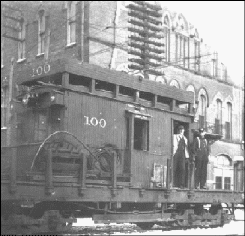
The interurban tracks ran through Sidney, including around the downtown court square. A former power station facility
still exists and is now home to Presser Auto Parts on 1282 Wapakoneta Avenue. A station in
Anna has been converted into a private residence.
'Downtown'
segment written in October, 1998 by Sherrie
Casad-Lodge
[ Back to Downtown Index ]
|