The Continent
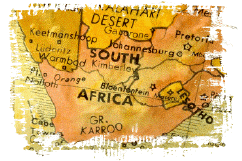
Africa: A land of enchantment, intrigue, and diversity. From Tunisia in
the north to the Republic of South Africa in the south (4,970 miles), and Senegal in the
west to Somalia in the east (4,700 miles), it is the world’s second largest
continent. Its more than 16,000 miles of coastline is bathed by the North Atlantic, South
Atlantic, and Indian oceans, as well as the Mediterranean and Red Seas. The continent is
basically a huge island with its only connection to another land mass, Asia, at the
Isthmus of Suez which separates the Mediterranean and Red Seas. The climate is mostly
tropical with indigenous flora and fauna that exists only in Africa. Its great beauty,
from vast grasslands to eastern mountains, deserts to lush vegetation, tropical birds to
animals of immense strength and size has enchanted individuals and the nations of Europe
for centuries.
Although northern Africa was known to the ancient Phoenicians (a
group of powerful cities on the eastern Mediterranean in the area of current day Lebanon),
they, along with the Greeks, Romans, Turks and Persians, knew practically nothing about
the vast lands south of a line through northern Sudan that extended across the continent.
Central and southern Africa was an enigma that remained unvisited and unchallenged by the
ancient and early empires of Europe and Asia.
It is difficult to understand why these great empires did not
explore the vast African continent that lay south of Sudan (Northeastern Africa). The
topography of the region and the climate apparently created an impenetrable barrier beyond
which humans did not wish to pass. Conjecture has it that ancient peoples believed that
the temperature of the lands south of the Sudan were too high for human survival.
'Black History' segment
written in June, 1998 by David Lodge
[ Back to Black History Index ] |