|
1930s to 1960s
The Depression of the
1930s, and the plight of blacks was captured in their slogan, "Last Hired and First
Fired." The Presidential election of 1932, and black support for Franklin D.
Roosevelt, Democrat, brought an end to majority black embrace of Abraham Lincoln’s Republican Party, and a loyalty to the
Democratic Party that, to a great extent, continues today.
During
W.W. II, posters featured Joe Louis, a black man that had fought in every American war. This was the first time in which
the black’s participation was advertised by the government. The fight became twofold
— one of fighting the racism of the German and Japanese governments as well as
fighting racism experienced at home. Blacks were prevented from holding supervisory jobs,
joining certain unions, living in white neighborhoods and attending many schools. During
this war, there were 16 million men in uniform, of which 1 million were black. There were
250,000 women soldiers of which 4,000 were black. On July 25, 1948, Truman signed
Executive Order No. 9981 to desegregate the nation’s armed forces.
The post World War II years raised public awareness of black
conditions, particularly since many had served with great distinction in a war against
ethnic injustice, suppression and discrimination, only to return as patriots to a society
that represented similar elements. Out of this, the civil rights movement was born.  There
was a general migration of blacks to the northern and western cities. The Supreme Court,
along with federal court rulings, in the 1940s and 1950s brought victories in education,
housing, recreation, and other areas where discrimination and segregation still festered. There
was a general migration of blacks to the northern and western cities. The Supreme Court,
along with federal court rulings, in the 1940s and 1950s brought victories in education,
housing, recreation, and other areas where discrimination and segregation still festered.
In the 50s, there were "Jim Crow" signs posted everywhere
that segregated blacks from whites. These laws were based on the U.S. Supreme Court’s
decision of 1896 in Plessy v. Ferguson that ruled blacks might be compelled to
accept separate accommodations as long as they were "equal".
In 1955, Rosa Parks was
arrested in Montgomery, Alabama, for not moving to the back of a city bus in violation of
city law that required blacks to move to the rear of the bus when whites wanted to sit in
a forward seat occupied by a black. Parks was arrested, resulting in the first organized
mass protest by blacks. During the mid 50s, blacks had lawyers in the courts, children
sitting on segregated school steps. and were walking in thousands of peaceful protest
marches. Out of this, a renaissance of black music was born — with freedom songs
leading the way. The boycott of the Montgomery city buses, lasting 382 days, forced the
rescinding of the law, and brought to national attention a new black leader, and man of
peace, Martin Luther King, Jr.
Joining King’s Southern Christian Leadership Conference (SCLC), in
August 1963, for a great civil rights march on Washington D.C., were - A. Philip
Randolph/Roy Wilkins of the NAACP, James L. Farmer of CORE, and
Whitney M. Young, Jr., of The Urban League, and 200,000 people, black and white.
King’s "I Have A Dream" speech inspired millions, brought international
attention to a new and powerful peace movement, and caused a young, first-term American
president to look inside the soul of America and to see continued black injustice.
As a result of this peaceful protest, President John F. Kennedy
proposed stronger civil rights laws that prohibited racial discrimination in public places
and guaranteed equal opportunity in employment and education. Kennedy’s assassination
in November 1963, and the succession of Lyndon Baines Johnson, a southerner, to the
presidency, seemed to put the new civil rights proposal in jeopardy. President Johnson
chose to carry out the wishes of the former president, and persuaded Congress to enact the
Civil Rights Act of 1964.
Martin Luther King, Jr., continued
his peaceful battle against the racial barriers and discrimination that still permeated
much of American society. His diligent effort for equality and reform resulted in the
Voting Rights Act of 1965; causing blacks to freely exercise their right to vote,
resulting in a substantial increase in the number of elected black officials. His voice,
but not his message, was silenced in Memphis, Tennessee, when he was assassinated by a
white man on April 14, 1968. Many black militant groups, (out of a frustration that
whites could not change) were born during this period, including the Black Muslims, the
Black Panthers and the Black Power Movement.
 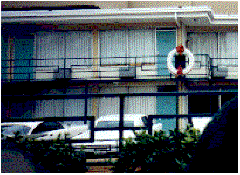
The National Civil Rights Museum is
housed in the Lorraine Motel, 450 Mulberry Street, Memphis, Tennessee, where Martin Luther
King, Jr. was assassinated. Visitors can see the motel balcony and a marker indicating where King was killed.
''Black History' segment
written in June, 1998 by David Lodge
[ Back to Black History Index ]
|