In the pioneer days, fabrics were made in the home using tanned calf-skins and
cowhides. A traveling shoemaker would then take the side of leather and turn it into pairs
of shoes or other items for the family. This all changed when local businesses were
established to meet the demand for tanning.
Tanning was perhaps Sidney, Ohio's first industry concentrating on the production of
material primarily for resale. James Starrett, (possibly related to Sidney founder, Charles Starrett), received land via a
federal land patent on North Ohio Avenue from President James Madison in 1812. Mr.
Starrett constructed a building there and transferred the property to John Whitmire in
1830. According to information found at the tannery, the building was torn down soon
after the construction of the canal and a much
larger building erected on this site. Mr. Whitmire began operating a tannery where
horse and cattle hides were cured then made into saddles, harnesses, and other practical
items for the settlers.
The enterprise was owned by a series of businessmen: Jason Tyler, Otho Evans, Robert
Given (later in partnership with S. A. Leckey), then Givens' sons, and finally the Henry
Roth family beginning in 1918. Enlarged many times over the years, the 'Tannery' was a
landmark in town for over 150 years. It was also one of the first concerns to establish a
market for its products outside Shelby County. By the 1880s, the company's leather goods
were sold throughout the western United States and as far away as Europe. The firm tanned
up to 6,000 hides a year. The tannery business continued at the same location until about
1979 when the Roth family closed it. The buildings were torn down by the city in 1996.
"The Sidney Daily News" reported in 1976 that June Roth was the only woman
tannery manager in the U.S., who became head of the business when her husband, H.E. Roth,
died of cancer in 1966. "You don’t go out and hire a professional manager,"
she said, "For a small family business. Sons are brought into the business. Why
not wives and daughters?"
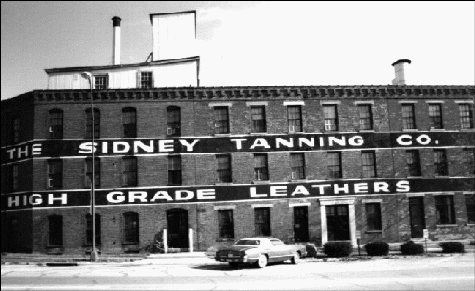
Now a parking lot, the Sidney Tanning
site is located on North Ohio Avenue just across the street from General Rental.
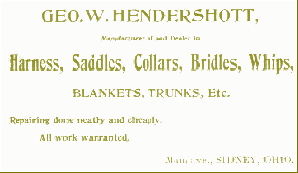
O. W. Hendershott was also in the local leather business by
1854. The author of an article in the Sidney Journal January 5, 1879 described him
as the "leading harness maker and dealer in the city." Hendershott had
apprenticed in the business beginning when he was just 14 years old - a typical approach
to learning a trade in those days. His shop was located at the northeast corner of Main
Avenue and North Street just across from what is now the William A. Ross, Jr.,
Historical Center, formerly the Haslup house.
Industry segment
written in January, 1998 by Rich Wallace