|
About the Paleo-Indians
Discoveries in the Meadowcroft caves
near Pittsburgh showed the presence of humans with lithic technology (a specific stage in
the use of stone by humans) dating back to 14,000 and 9,300 BC. This would appear to
indicate that such humans also resided in present-day Ohio. Flint arrowheads found at
Meadowcroft date back to 10,800 BC. Paleolithic humans, or, as some experts prefer,
Paleo-Indians resided in the Ohio Valley area that also includes Shelby County. These
Paleo-Indians continued to migrate over hundreds of years from the north into the United
States, the Ohio Valley and areas beyond.
Some archeologists believe that many of the earliest hunters arriving in our area may
have taken a more northerly route across Canada to the Great Lakes, then moved south and
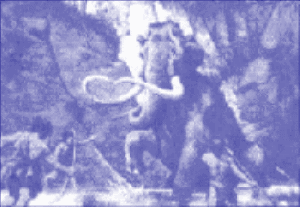
east in search of prey. Their principle source of food was the great mastodon (an
elephant-like mammal pictured above), that migrated into this region after the ice
retreated. Other species that followed the mastodons into the United States from Asia via
Beringia included, mammoths, caribou, bison, musk ox and elk.
It is interesting to note that only 7,500 years ago, a portion of what is now Lake Erie
extended as far south as Allen County. The Great Lakes, including Lake Erie, are the
residue result of the melting glaciers as they retreated northward. No skeletal remains
from the Paleo-Indian people have been found, so their physical characteristics remain a
mystery, however, they probably resembled pre-sapian Neanderthaloid man whose structure is
known from remains found in China. Many of their tools (rocks shaped and sharpened to
stab, slice, scrape or stun) and artifacts have been discovered throughout the Americas,
including Shelby County, Ohio. However, while there have been a lot of animals found in
Ohio, there has never been a pre-historic animal found with a projectile point which would
signify a connection with human beings.
According to Indian artifact expert, Robert Converse, a common problem is an
owner’s desire to quickly excavate causing artifacts and evidence of life to be
partially destroyed or lost forever.
'Indian' segment written in December, 1997 by David Lodge
[ Back to Indians Index ]
|