|
German-American
Bank is Formed
As business and industry prospered in the county, the First National Bank was
chartered in 1864. Charles Weaver joined the bank in 1868 and John Wagner around 1869.
Both quit the First National in 1875 to work together in the formation of the German
American Bank. (John Wagner was of German heritage).
The new bank was very popular, particularly amongst German immigrants and those of
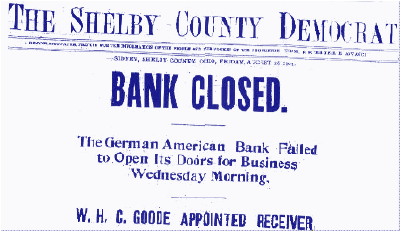
German descent. One can imagine their dismay upon reading the large headlines in "The
Shelby County Democrat" newspaper of Friday, August 26, 1904, which reported, ‘Bank
Closed. The German American Bank failed to open its doors for business Wednesday morning. W.H. C . Goode appointed receiver.’ The
Democrat also reported, "It is very well understood that the bank had a large
number of depositors, most of whom placed their money there on account of the confidence
in the bank officials and the liberal interest paid to time depositors."
Friday, October 28, 1904, the Democrat headlines read, "BANK REPORT. The report
of the Expert Examiner Shows a Cash Shortage of $231,677.57. Instead of a surplus of
$109,000 as represented by the Bank there is a deficit of $250,390.06. Overdrafts amount
is $158,790.03. Bank insolvent ten years but dividends of $60,000 paid in that time. No
directors meeting since 1896. Liabilities $806,771.73 but may be reduced to $725,000..."
Many of the bank’s original directors had died or retired and it appears that a
number of board positions had remained unfilled. According to the newspaper, "the
officials of the bank well knew that this condition existed for months, yet in the face of
this knowledge, they took money from depositors up to the very last moment before closing
the doors, and went out and had checks and drafts cashed that they had taken in that day.
They also went out and solicited deposits when they well knew there was no possibility of
paying them if the deposits were made."
Since the institution was privately held, the stockholders were responsible for the
bank’s debts. Examiners would look over the books for weeks, finding numerous
discrepancies. The receiver took immediate possession of the bank assets and Frank D.
Reed’s (the cashier) Cottage at Orchard Island. The newspaper printed to the last
penny the appraiser’s evaluations of the estates of Frank and Mary Reed as well as
Bank President, John Wagner and officer, Peter Wagner. Other area banks assured its
customers that the fate of the German American Bank would have no effect on their own
deposits. The German-American Bank’s failure was the subject of contentious
discussion within Sidney and Shelby County, Ohio, for many years.
'Immigration'
segment written in November, 1997 by David
Lodge
[ Back to Immigration Index ]
|