|
Namesake of Sidney
The new town was named after Sir Philip Sidney, an English patriot,
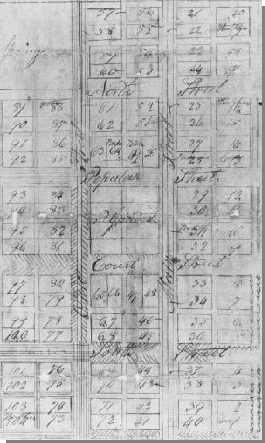
writer and member of parliament. The first plat of Sidney, Ohio, was filed on February 24,
1820, and with the county recorder on April 18, 1820.
David Henry hired Benjamin Cox, a surveyor, to lay out the town in 113
lots. Responsible for selling the lots, Henry then gave a 30 day notice of a public
auction for these lots in 6 public places throughout the county as well as newspapers such
as the Dayton Gazette. As noted in documents found from the period, early spellings
of Sidney did include variations such as ‘Sydney". As a matter of fact,
in the first book for recording deeds, the plat of Sidney was spelled ‘Sydney’.
The original boundaries were from North Lane to South Lane, (now Water
St.), and from the Miami River to West Lane (now West Ave.). Each of the 113 lots measured
5 by 10 rods. The principal streets were six rods and the alleys one rod in width. (A rod
is 16 1/2 feet). The streets of the original plat were considered to be uncommonly wide
for their time but are today more than adequate enough to meet modern traffic needs.
Lot 113, in the rear of the Presbyterian Church, for which Lot 109 was
granted, was set aside as a graveyard; Lot 101, at the corner of West Ave. and South St.,
was for religious societies, and the east half of Lot 105 was devoted to school purposes.
Central school sets upon this lot today.
Even though some historic buildings are gone, and vacant lots do exist,
the downtown area of Sidney, Ohio is nearly the same as when it was first laid out.
Plat of Sidney
'Downtown'
segment written in October, 1998 by Sherrie
Casad-Lodge
[ Back to Downtown Index ]
|