|
Final Action in the West
After the fall of Atlanta,
those units that did not accompany Sherman were sent back into Tennessee chasing General
John Bell Hood and his retreating rebels. Two decisive battles ended the flickering
fortunes of the rebels in the west. The 118th Ohio was involved in both.
Hood first met the Union forces at the little town of Franklin, Tennessee,
on November 30, 1864. Hood, who had to be strapped in his saddle every morning, ordered
his 18,000 men to charge the fortified federal lines. Civil War author Bruce Catton
described the action in the "Picture History of the Civil War" as follows:
"Hood ordered a frontal assault on the federal line, sending 18,000 men
forward through the haze of an Indian-summer afternoon in an attack as spectacular, and as
hopeless, as Pickett's famous charge at Gettysburg. Never was a charge driven home more
heroically, or at a greater cost — to a more dismal defeat."
The Confederate killed, wounded, and captured totaled
6,252 men, including 6 generals. Dr. Albert Wilson witnessed it all. In a letter home
dated December 24, 1864, he wrote, "The citizens of Franklin report that after
the battle, there are 990 rebels laying dead in the field, their killed and wounded
amounting to over 7,000."
A desperate Hood faced the Union army again two weeks
later at Nashville. With a vastly superior force, the federals charged and destroyed
Hood's army, the only time in the war the Confederates were routed on the field of battle.
Dr. Wilson was ecstatic: "The battle of the 16th was a magnificent affair. The long
lines of battle as they moved forward in the charge with their colors floating was a scene
not soon to be forgotten." The war was over in the west.
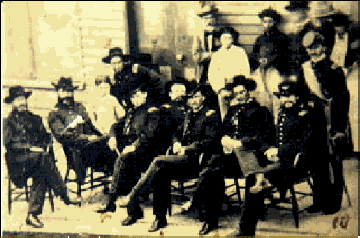
Officers of the 118th O.V.I. pose for
the camera
'Civil War'
segment written in July, 1998 by Rich Wallace
[ Back to Civil War Index ]
|