|
Financing the Canal
Ohio was a primitive state in the 1820s, both
from a civilized and a financial perspective. Prior to considering the building of the
canals, Ohio had never undertaken any significant public improvement projects. No private
industry had been developed by then to help. The recently formed federal government could
not assist financially, but it did donate over one million acres of land, primarily in
northwest Ohio, to the state of Ohio. This land was sold in minimum lots of 80 acres. Over
two million dollars was generated for canal construction.
Ohio followed New York's
successful lead. A Canal Fund Commission was established to issue bonds which were to be
sold in the eastern financial markets. As each completed section of canal began to earn
money in the form of toll charges, the issuance of more bonds was justified, which created
funds for additional construction. The Canal Commissioners also received donations of land
from those landowners along the proposed route, further reducing the costs of land
acquisition and canal construction.
Beginning near established market areas, such as Cincinnati, completed sections of the
canal immediately generated funds, which were in turn used to finance more construction
and sell more bonds. Given its impoverished start, financing of the canals was a bright
spot in its history. Many other states defaulted on their canal operations, but Ohio never
did.
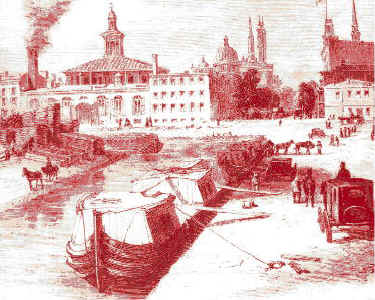
The basin of the Miami & Erie Canal in Cincinnati, Ohio.
'Canal' segment written in
December, 1998 by Rich Wallace
[ Back to Canal Index ]
|