|
The Demise of the Canal
The Miami & Erie Canal, efficient and
profitable in its prime, was the victim of technology and changing consumer demand for
products. Steam railroads, with the twin
advantages of lower costs and faster shipping, played the major role in dooming the canal.
Sidney had two major steam railroads by 1856, the north and south running Dayton and
Michigan (now CSX) and the Bellefontaine and Indianapolis (later Big Four and now
Conrail).
Old-timers recalled that the ice industry was the first to vanish after the
ice boats from Cincinnati stopped coming. As the great virgin forests began to disappear,
farmers ceased cutting timber in the winter, and the timber boats from the south went
elsewhere. The last local product was stone from quarrying operations in the western part
of the county. The demand for that declined with the invention of concrete. In an
effort to increase the efficiency of canal operations, the state leased the canal to
private parties from 1861 to 1878. This venture was not successful, as the General
Assembly granted special financial incentives to those who leased the land, thus costing
the taxpayer more than when the state ran the system. As noted earlier, the required canal
maintenance was also neglected by the private contractors.
There was little commercial or passenger traffic on the canal by 1900. Ruth Emmons of
Sidney recalled that the last canal boat that came to Sidney arrived in 1904 or 1905.
Captain Billy Coombs, a Newport native, has the honor of piloting the last boat on the
canal in this area. He made the last run from a gravel pit outside of Newport to Ft. Loramie in 1912. A canal boat operated
by Capt. Harry Newton crashed into the aqueduct carrying
the canal over Loramie Creek in 1912, severely damaging it. State officials refused to
repair it.
The final devastating stroke was the great flood of 1913. Jack Gieck, in his
book, "A Photo Album of Ohio's Canal Era", summarized the effect of the
flood on the canal. "March 1913 brought Ohio's canal system to an abrupt
end. After a winter of record snowfall, spring rains had been abnormally heavy. All the
reservoirs were gorged with water, and the excess spilled over into the canals, turning
them into torrents in many places - destroying aqueducts, washing out banks, and flooding
adjacent towns and countryside." It was apparent that the cost of repair
could not be justified. The canals were officially abandoned as a transportation system.
The canal continued to hold water for a long time after the flood in some areas. The
boat 'Lenita' (shown at the top of this page) was used in Sidney for pleasure
cruises for many years. Built in 1910 by Sidney resident Pete Smith and employees of the Bimel Buggy Company, the 'Lenita' had a gasoline
engine. The craft was owned and maintained by the Verdier family of Sidney.
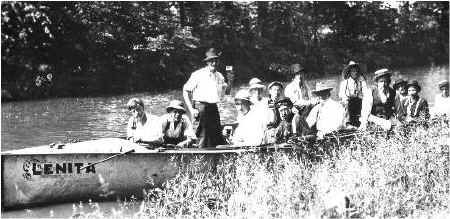
The Lenita
| The Sidney Feeder Canal provided a
source of entertainment in the winter as well. Area residents recall ice skating from
Sidney to Port Jefferson and back when the water in the canal was frozen.
Efforts were
made to use portions of the canal lands and save its structures over the years. Martin
Quinlisk, Shelby County's representative in the General Assembly in Columbus, introduced a
bill in 1915 to drain part of the Loramie reservoir and create a state park around the
remaining lake. Thus, Lake Loramie and the park system there were developed.
Other efforts were largely unsuccessful because of lack of funding. Local and state
efforts to repair and save the magnificent Turtle Creek
Culverts in Washington Township were launched in 1978. A preliminary study projected
the cost of repair at $240,000. Because the collapse of the culverts would result in
flooding of adjacent farmlands, the decision was made to tear down the culverts in 1980.
Some restoration has taken place in Lockington, where a
state park incorporates the five locks in the village. State funds were used in 1986 to
shore up Lock No. 1 with wooden bracing.
Piqua residents, in cooperation with state and local officials, recently completed the
renovation of Lock No. 9 in downtown Piqua. It is located in a city park on East Water
Street one block east of Main Street, and is open to the public.
Many stretches of the canal remain relatively intact. Good examples of the canal can be
seen in Washington Township and the Village of New Bremen. North of Lockington, the
Buckeye Trail follows the canal for a number of miles.
Ohio Historical Society officials decided in 1966 to reconstruct a canal boat at the
Johnston Farm park outside of Piqua. After acquiring 3 miles of canal right of way,
efforts were initiated to design and build a boat. Little original design information
could be located. The craft, named the General Harrison, was finished in 1971.
Rides on the boat, which is pulled by two mules, are available daily. A museum is located
near the dock. |
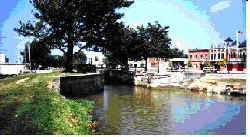
New Bremen
|
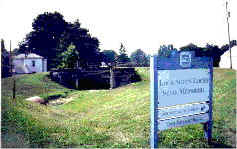
Lockington State Park
|
|
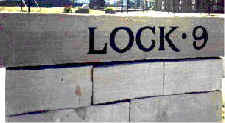
Lock 9 in Piqua, Ohio
|
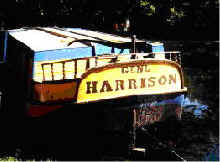
General Harrison canal boat replica
at
Johnston Farm in
Piqua.
|
Johnston Farm was named in honor of John Johnston, a noted Indian agent. He lived on the farm and
discharged his duties as agent between 1802 and 1829. Johnston shipped pork and fruit from
his farm on the canal to Cincinnati. General William
Henry Harrison, who later would become president of the United States, was a visitor
to Johnston Farm. John Johnston also served as member of the Ohio Canal Commission.
Despite
its brief time in existence, the Miami & Erie Canal had a greater impact on the
development of Shelby County, Ohio than any other event or project in its history. Pioneers, struggling to survive in the vast
wilderness, immediately began to participate in the country's emerging free market
economy. Prosperity was more than just a pipe dream. Historian Harlan Hatcher summed up
the importance of the canal as follows:
"This trickle of water, conducted through the valley between low, man-made
banks, first connected (our) interior with New York, New Orleans,...and the markets of the
world. It expressed the vision and hopes of our fore-fathers. It was...their magnificent
gamble with their destiny. On its four feet of water floated the products of their toil.
It made all the difference between a stagnant and isolated western theater and a thriving,
prosperous and growing region linked up with the rest of the world. It was, in short, the
ditch that brought the world to the wilderness."
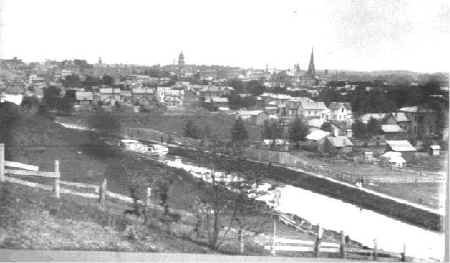
Pictured below is a panorama view of Sidney from the south end of the city which shows
a supply-laden canal boat making its way up the canal. Photo courtesy of city of Sidney.
'Canal' segment written in
December, 1998 by Rich Wallace
[ Back to Canal Index ]
|