|
Building the Canal in Shelby County
Work had begun on the flat stretches of land
here by the mid-1830s, before the canal was opened to Piqua in July, 1837. Local
contractors bid on the work by sections. Teams of oxen and mules provided the power to
haul away the material and deliver stone. The laborers worked with wooden scoops, shovels,
and wheelbarrows. J. W. Akin of Houston was awarded a contract for one mile of the
canal in Shelby County. J. W. Schworer and B. Ortman of Minster also were awarded sections
of work. Although the minimum top width of the canal was specified to be 40 feet, the
canal in this county averaged 45 feet wide.
Shelby County, Ohio, was covered by virgin
forests during this time. The canal builders often encountered trees with a diameter of
seven feet or more. These giants had to be cut down, and the stumps removed by hand. The men lived near the work site
in shanty towns where unsanitary conditions and disease were common. Working conditions
were miserable during much of the year, with freezing temperatures in the winter and the
threat of malaria (known by the canalers as 'auge'), cholera, and other diseases in the
summer. These problems were especially prevalent in Shelby County because of its swampy conditions. Terry Wright has written that,
for each mile of the canal, at least one worker died of sickness or winter exposure.
Fort Loramie historian Clarence Raterman recorded in 1940 the experiences of Henry
Meyer working on the canal, as related by his grandson, Richard Thaman. Meyer was a
contractor on the canal. He had to feed and board his crew, so he took his wife along to
cook for the men. The son of an area family, Henry Berning, worked for Meyer as a water
boy. Meyer later recalled that after his men had dug out the canal bed, clay was applied,
and cattle were driven down the canal to seal the bed. Meyer was quoted as saying, "I
never asked any man to do something I could not do. My work was the measure of what I
expected from my men. When I rested, they rested."
Meyer went to Piqua every two weeks with a cart to pick up supplies. On one occasion,
he was attacked by a pack of wolves, and he escaped by climbing a tree. He stayed there
until the next morning, when workers from his camp drove off the wolves. On another day,
Meyer looked up in a tree beneath which he was passing, and saw a large snake coiled on a
tree branch just above his head, getting ready to strike. The contractor moved on before
the snake could react. Forest Blanchard, in an article on the canal activities near the
Shelby County village of Oran, described how local farmers who owned a team of oxen or
horses were paid $1.25 a day to work on the canal. With land prices then at about the same
price per acre, Oran area resident Samuel Penrod amassed almost 600 acres of land by
providing such services.
The canal bisected many roads along the way. Travelers on the roads had to have a way
across the canal. In many cases, this problem was solved with a 'swing' or 'bump' bridge.
This bridge would allow a horse and buggy or wagon to pass over the canal. Canal boats
would approach the bridge and bump the structure, pivoting it out of the way. Some bridges
were more substantial in character.
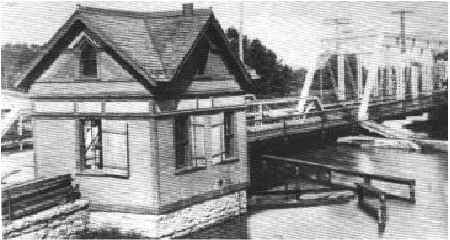
Piqua's steam-operated swing bridge over the canal on Main
Street, ca. 1910. The small building contained the steam engine that operated the
mechanism. |
| Work stoppages were common when the canal work
was at its height in Shelby County, Ohio, and the rest of the nation was in the midst of
an economic depression known as the 'Panic of 1837'. It was eight years before the entire
Miami & Erie Canal was completed, and the county residents could enjoy the full
benefits canal business had to offer. The Sidney Feeder was 14 miles long, beginning at a
dam on the Great Miami River just north of Port Jefferson, and ending at Lock No. 1 in
Lockington. It was built 50 feet wide at the top, and contained no locks. The feeder canal
paralleled the Great Miami River most of the way from Port Jefferson to Sidney. It entered
Sidney from the northeast and moved in a southwesterly direction through the center of
town, passing behind what is now Crescent Avenue.
'Canal' segment written in
December, 1998 by Rich Wallace
[ Back to Canal Index ] |
|