|
Feature Article on Carry Nation. Topic: WOMEN &
PEOPLE
Written by Jim Sayre in February,
1997
TEMPERANCE MOVEMENT HAD ROOTS
IN SHELBY COUNTY, OHIO |
The November 1996 Victorian
Evening at the home of the late Mr. and Mrs. William H.C. Goode (Sidney’s Greatstone Castle) gave local
residents a glimpse of the genteel lifestyle of the late 19th century. The hostess for the
evening, Mrs. Goode, charmingly portrayed by
Sherrie Casad-Lodge, was the epitome of good taste and gracious manner, a credit to
Victorian womanhood. Another Victorian lady, also with ties to Shelby County, was not such
a gracious lady.
This lady was a general of the anti-alcohol temperance
movement, the famous 6-foot, 175-pound, hatchet-wielding, saloon-wrecking Carry Amelia
Nation. 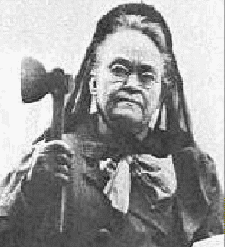 The gentle Mrs. Goode, member of Sidney’s Methodist Church which sponsored
temperance lectures and meetings, and the warring Mrs. Nation represent the multifaceted
campaign in the late 1800’s against the abuses of alcohol in Shelby County, this
state, and across the Nation. Oddly enough, the father-in-law of Carry Nation, that great
anti-booze warrior, operated a tavern just west of Sidney in the tiny Cynthian Township
hamlet of Newport. The gentle Mrs. Goode, member of Sidney’s Methodist Church which sponsored
temperance lectures and meetings, and the warring Mrs. Nation represent the multifaceted
campaign in the late 1800’s against the abuses of alcohol in Shelby County, this
state, and across the Nation. Oddly enough, the father-in-law of Carry Nation, that great
anti-booze warrior, operated a tavern just west of Sidney in the tiny Cynthian Township
hamlet of Newport.
In Newport, Harry Gloyd, a one-time justice of the peace and tavern keeper, raised his
son Charles. This Charles would develop into a full-blown alcoholic, wed the young Carry
Moore, and die not long after she reluctantly, but quickly, divorced him.
Much later, remarried to attorney and preacher David Nation
and immersed in the fight against alcohol, Carry Nation would attribute her crusade to the
horrors she experienced while married to Shelby County’s Charles Gloyd. "Whisky
is a cruel tyrant and a worse evil," she said. Following Charles’ death in
1868, and feeling remorse for having left him, Carry blamed "the curse of drink
and tobacco and the Masonic Order," where she believed Gloyd had done much of his
drinking, according to Beals’ book Cyclone Carry. "Later, she
would strike out against the snakes of evil she believed had destroyed him."
Carry and her second husband, David Nation, settled in
Medicine Lodge, Kansas, in the early 1890’s where she soon launched her historic,
nationwide crusade against drinking. Using a hatchet to ruin saloons (she called it
"hatchetations"), Carry believed in divine guidance and that her name (Carry A.
Nation) had been preordained. Continuing her crusade in many American cities, she was
arrested 30 times for disturbing the peace. She would "appear at a saloon, berate
the customers, and proceed to damage as much of the place as she could with her hatchet.
She was the scourge of tavern owners and drinkers alike" (Compton’s
Interactive Encyclopedia). |
Carry Nation’s free-swinging assaults on
saloons came nearly 20 years after a widespread movement against liquor interests by
Victorian ladies using tactics akin to those of Ghandi and Martin Luther King in the next century:
nonviolence. In 1873, groups of church women in Ohio towns including Hillsboro, Washington
Court House, Cincinnati, Columbus, and Cleveland staged marches and prayers-in at local
drinking holes, establishing their tactic of embarrassing saloon keepers and their
patrons. "The ladies’ success was due in part to the deference most men still
showed ‘women of quality’ in the Victorian Era" (Ohio and Its People,
by Knepper). Such demonstrations caused a temporary suspension of liquor traffic, but
local laws against obstructing the streets soon curbed the ladies and the flurry of
anti-saloon activities subsided within a year.
Nation’s later
"hatchetations" would become an embarrassment, not to saloon keepers who were
more often just plain angry, but to the "women of quality" who would sing hymns
and pray outside saloons, but abhor the unlady like violence that became Nation’s
trademark. Area towns were not exempt from the "grand crusade." Following a few
weeks of demonstrations in Shelby County, the Sidney Journal reported ..."The
saloons at Newport (maybe one once operated by Gloyd) have quit selling whisky by the
drink..." (SJ, Apr. 3, 1874).
Snow was falling on Piqua’s streets in late January 1874 as two hundred women,
after meeting at the First Presbyterian Church, marched on the city’s saloons reading
the word, singing, and entreating the owners to close their evil establishments (Women
and Temperance, Piqua, Ohio, by Oda). The bartender at the City Hotel confronted the
women by declaring "I must take a bath" and then began removing his
clothing. Buckets of cleaning water thrown in their direction were among the indignities
visited upon the crusaders.
The active street work of the women. Crusaders gradually
came to an end as fewer women were willing to brave the scorn of the saloonkeepers for
such inconclusive and often very temporary results...Many of the women turned to
the...local chapter of the Women’s Christian Temperance Union" organized in
mid-February, according to Oda. Piqua had supported three breweries and nineteen saloons
in 1870, but the saloons closed after Piqua’s prohibition ordinance went into effect
several years later (Oda; SJ, Apr. 3, 1874). Temperance lectures at the Methodist Church in
February 1874 and organization of a "Woman’s Whisky War" soon after at the
Presbyterian Church marked the beginning of Sidney’s temperance movement. "The
ladies of Sidney are thoroughly organized, equipped, and disciplined, and have a large
squad of men in the rear to support them with their counsel, money, and even assistance if
necessary," the local paper reported (SJ, Feb. 13, 1874). "Mrs. Wykes was
elected President, Mrs. Thomas Stephenson, Vice President, and Miss Ella Rogers,
Secretary."
"On Tuesday morning the band of praying and singing
women turned out, and numbered nearly fifty," the Journal reported a week
later (SJ, Feb. 20, 1874)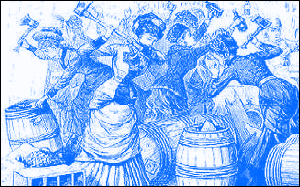 . "The women engage in the work about six hours a
day. They devote about half an hour to each saloon...Two prayers and three hymns are given
for the benefit of each place they visit...The first day the women were out George D.
Barkalow, who kept liquors in connection with his groceries, surrendered. He has
determined to retire from business, and having only a few gallons of whisky on hand, he
deemed it policy to capitulate...and this morning Craft & Martz and C. Stuber have
announced their determination to give up the business." . "The women engage in the work about six hours a
day. They devote about half an hour to each saloon...Two prayers and three hymns are given
for the benefit of each place they visit...The first day the women were out George D.
Barkalow, who kept liquors in connection with his groceries, surrendered. He has
determined to retire from business, and having only a few gallons of whisky on hand, he
deemed it policy to capitulate...and this morning Craft & Martz and C. Stuber have
announced their determination to give up the business."
Despite early success, the movement showed signs of
faltering. "It can not be said that the movement has as yet had any effect in abating
drunkenness or drinking," (SJ, Feb. 20, 1874). "There were more
intoxicated men in Sidney on Sunday than we ever knew. Dealers in whisky say that the
demand for the article by the quantity is largely in excess of former times. The brewery
of Wagner Brothers is running double its former
capacity the present week."
And, the crusade was caught in some inappropriate
private sting operations. In the words of the Sidney Journal: "Some of
the efficacy of the ‘Woman’s Whisky War’ in Sidney has been vitiated by
imprudence accompanying it. Divers attempts have been made to induce liquor dealers to
sell to minors. On Saturday evening two boys made application at the grocery of N. Levi
for a pint of whisky. Their design was anticipated, and when questioned they said they had
been furnished with the money by James R. Fry and sent to get the whisky. These
transactions were no doubt instigated by men conspicuous in the movement. The cause has
also suffered from men who join in the cry for temperance and persist in imbibing
intoxicating drinks" (SJ, Feb. 27, 1874).
The outcome of the crusade had been in doubt from its
beginning. "The excitement in Sidney in consequence of the temperance agitation has
been subsiding for a few days," reported the Journal (SJ, Feb. 13,
1874). "There is not as much flutter and anxiety 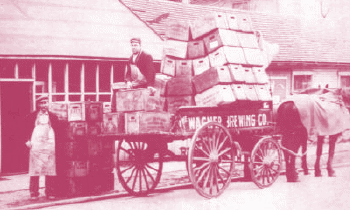 among the saloon keepers as there
was a week ago. Some believe that it will be spasmodic, and that it will be of short
duration. The demand for whisky in large quantities has been greatly on the increase for
the past ten days." By the end of March, the Journal reported that "the
female combatants of whisky are still in their harness in Sidney," but "..the
movement, having lost all its novelty, is attracting very little attention" (SJ,
Mar. 27, 1874). News of the local movement then largely disappeared from the Journal. Finally, in August, came this forlorn, syntax-challenged announcement: "The call for
a meeting of the temperance people of Shelby county, in Sidney, last Saturday, was not
numerously responded to" (SJ, Aug. 7, 1874). " among the saloon keepers as there
was a week ago. Some believe that it will be spasmodic, and that it will be of short
duration. The demand for whisky in large quantities has been greatly on the increase for
the past ten days." By the end of March, the Journal reported that "the
female combatants of whisky are still in their harness in Sidney," but "..the
movement, having lost all its novelty, is attracting very little attention" (SJ,
Mar. 27, 1874). News of the local movement then largely disappeared from the Journal. Finally, in August, came this forlorn, syntax-challenged announcement: "The call for
a meeting of the temperance people of Shelby county, in Sidney, last Saturday, was not
numerously responded to" (SJ, Aug. 7, 1874). "
While the public’s ardor for temperance in Sidney
cooled, the abuses of alcohol continued, as the Sidney Journal colorfully reported
10 years later: "On Saturday John Johnson, blacksmith, a young man, put in the day
going from saloon to saloon, until he seemed to feel the thrill of Samson’s strength,
and fairly ached for a chance to exhibit it. He swaggered along the sidewalks, full of
oaths and obscenity, emphasizing his swagger by defying all authority. Between 7 and 8
o’clock he was arrested midway between Main and Ohio streets in Poplar street, and at
once resisted the officer, striking him with all his might. Other officers came up to
assist, and a crowd of two hundred or more congregated. A large number of roughs, pals of
Johnson, rushed in, striking right and left, cursing and denouncing the officials, and
interfering with their discharge of duty. A riot was imminent, as the mob grew fierce.
Johnson at last was manacled, after a sound and wholesome beating, and taken to jail. On
Monday morning he was arraigned before the Mayor, plead guilty, and was sentenced to
fifteen days in the city prison on a diet of bread and water" (SJ, Aug. 22,
1884).
The Shelby County Democrat also
recorded the evil: "An anti-prohibitionist applied at a Sidney drug store on Sunday
for a pint of alcohol. He was informed that it could not be had...only for medicinal or
mechanical purposes. He was equal to the emergency, and stated that a friend had a horse
which was in a critical condition with a sore leg, and that nothing short of a pint of
alcohol would save its life. The plea was not accepted, and the person left without the
remedy, expressing his conviction that the horse would surely die!" (SCD, July
23, 1886).
As direct action against saloon keepers subsided in Sidney and other towns
throughout the country, the crusaders turned to legislative efforts and, in today’s
parlance, political action groups to carry on the fight against alcohol. But, in an era
when mainstream anti-alcohol organizations and political forces were building, Carry
Nation still subscribed to the old method of direct confrontation with saloon keepers,
although a confrontation of a far different kind. Ohio led the nation’s campaign
against liquor interests. Mrs. Rutherford B. Hayes, wife of the President from Ohio,
spurned alcohol for drinks of a softer nature in the White House and became known as
"Lemonade Lucy." Many elections in the mid-19th century were decided on the
basis of "wet" or "dry," and formal groups organized political forces
to outlaw the sale of liquor.
The temperance movement was described by one Ohio historian as "that perennial
football of Ohio politics." A prohibition candidate had run for governor as early as
1869 and the Democrats, profiting by the wet tendencies of the majority, demolished the
Whig party in the 1853 Ohio elections (A History of Ohio, by Roseboom and
Weisenburger). Political candidates were often forced to publicly announce their views on
the liquor issue. "No political campaign fought in Ohio in the late nineteenth and
early twentieth century was free from the ‘wet’ versus ‘dry’
conflict" (Ohio and Its People, by Knepper). Legislative action on statewide
prohibition, local option on the sale of alcohol, liquor taxes, licensing systems--even
"passage of a bill that restricted dramatic musical entertainment on Sunday when
associated with the sale of liquor" ( Roseboom and Weisenburger)--became almost a
political pastime in Ohio.
If the temperance movement was a political football, the Sidney
Journal was not above getting in a few local kicks. One can puzzle over the exact
meaning of this November 23, 1888, editorial comment: "The Prohibition party has come
out fairly and squarely as the Absorption party. Having absorbed all the cranks scattered
around, it fancied it could suck up the Republican party when it was in the minority. Now
that it has come out ahead, they have concluded to absorb the Democratic. If they do, it
means a dead drunk for an indefinite period." The local Journal a month later
took on the Prohibitionists’ arithmetic relating to the 1884 and 1888 national
elections. "When the Prohibitionists boast of having gained 63 per cent, cite them to
Belva Lockwood, who increased 150 per cent in the same time, as she got four in 1884 and
ten in 1888" (SJ, Dec. 14, 1888). Lockwood, an attorney, suffragist, pacifist,
temperance leader, and the first woman to argue a case before the U.S. Supreme Court, ran
as the National Equal Rights Party candidate for President in the two elections.
Ohio’s "perennial political football" is still in play. Just a few
months ago, the state government announced the privatization of the last remaining state
liquor stores set up in 1933 after the repeal of prohibition to reassure anti-alcohol
forces that the now-legal booze would nonetheless be kept well controlled.
The first national convention of the
Prohibition Party in 1872 in Columbus, the founding of the Women’s Christian
Temperance Union (WCTU) in Cleveland in 1874, and formation of the Anti-Saloon League in
Oberlin in 1893 firmly established Ohio’s leadership in the temperance movement. The
Anti-Saloon League’s first national convention in Columbus in 1913 advocated a
prohibition amendment to the U.S. Constitution. This became fact in 1919 when the 18th
Amendment was ratified, instituting prohibition, the nation’s great but eventually
failed experiment in legislating public morality.
Shelby County citizens gave early
support to the Anti-Saloon League’s efforts. In March 1911, Mrs. N.C. Enders,
great-aunt of Barbara Adams (Perry Township), signed the following pledge to The
Lincoln Legion, the Westerville, Ohio, based "abstinence department" of the
league: "I hereby enroll with the Lincoln Legion and promise, with God’s help,
to keep the following pledge, written, signed and advocated by Abraham Lincoln: --
Whereas, the use of intoxicating liquors as a beverage is productive of pauperism,
degradation and crime, and believing it is our duty to discourage that which produces more
evil than good, we therefore pledge ourselves to abstain from the use of intoxicating
liquors as a beverage."
Yet the "snakes of evil" prospered in Ohio despite its stellar achievements
against drinking. Cincinnati, for example, was home early in this century to the
nation’s largest distillery industry and the third largest brewing center. Under the
local option laws, Shelby County consistently surfaced on the wet side, while Miami County
always voted dry. The Western Ohio Railway, the interurban connecting Sidney with Piqua
and other points south early in the century, was known in some quarters as the
"drunkard’s express," as our Miami County neighbors, knowing a drink was
just a short ride north, voted the righteous way.
Carry Nation, once married to an alcoholic and later raging
publicly against drinking, represents on a personal level the larger scale alcoholic
schizophrenia long characterizing Ohio’s political, economic, and social affair with
liquor: . prohibition leadership in a state where the majority was politically wet, public
demonstrations against saloons in a state with strong economic ties to the liquor
industry, dry counties neighboring with wet counties, and state control of alcohol as a
sop to anti-drinking forces while still accommodating the drinkers. Decades after
his death, the drunken Charles Gloyd was still very much on Carry Nation’s mind even
as her hatchet tours were in full swing. On a stopover in Troy just after the turn of the
century, she made a bitter-sweet inquiry about his father who once lived in the area.
The April 4, 1901, the Miami County Union newspaper reported on Carry Nation’s visit and her questioning of those gathered:
"Mrs. Carry Nation, who achieved some notoriety in Kansas by smashing saloons, passed
through Troy Saturday enroute from Springfield to Indianapolis via the Big Four. "She
inquired of the small crowd on the platform if anything was known of Squire Henry Lloyd,
who was a Justice of the Peace in the vicinity about thirty-five years prior, and
volunteered the information that he was her father-in-law. Nobody could give her any
information concerning the father of her first husband and the train pulled out with
everybody’s curiosity gratified except that of Mrs. Nation herself" (Troy
Historical Society, Juda Moyer).
Little wonder no one recalled him; the Gloyds
had long left the area. Mr. and Mrs. Gloyd (not Lloyd) had moved to Missouri to be with
their son Charles in 1867. Harry (not Henry) was elected justice of the peace on August 7,
1847, and August 2, 1853, in Cynthian Township. Describing Charles Gloyd, Carleton Beals
writes that... "In Newport, Ohio, his father had been justice of the peace and held
court in the front parlor. As a boy Charlie listened in. Drunk cases so disgusted him that
he would lock himself in his room to escape the sight, sound, and smell of the victims. A
hatred of alcohol took hold of him--but hate is often the reverse side of love."
The
1850 national census noted Charles as a 10-year-old whose father Harry, age 51, was listed
as a "Tavern Keeper" owning $100 worth of real estate. Gloyd had applied to the
county government for a tavern license on May 11, 1850 (minute bk. 7, p. 429, Shelby
County Common Pleas Court). Charles’ mother’s name was Nancy, age 45, although
the Beals book on Carry Nation’s life consistently refers to her as "Mother
Gloyd," not once mentioning her given name. All three named Vermont as their
birthplace in the 1860 census, thus marking their move to Cynthian Township sometime after
Charles’ 1840 birth and before Harry’s 1847 election as a justice of the peace
there. "Hotel" is listed as Harry’s occupation in the 1860 census.
Just where Harry Gloyd maintained his 1850 tavern or his 1860-vintage hotel business is
unclear, although the need for both endeavors in that early canal town was self-evident. The only real
estate deed for Harry Gloyd held by the Shelby County Recorder’s Office is for lot 27
in Newport on the southwest corner of
High Street and Main (State Route 66), across from the Church cemetery.
It is dated July 31, 1850. The 19th century building is now
gone. The deed from "James and Mary Kiplinger" and witnessed by Samuel Clark, a
Justice of the Peace in Loramie Township, noted a "consideration of Seventy
Dollars," not far off the $100 in real estate noted in the 1850 census. Was this the
tavern? His home? Did he own other property, with no deeds recorded? And, since the
Recorder’s Office shows that Gloyd sold the property in 1854, what of the hotel
business noted in the 1860 census? Tavern keeper, justice of the peace, and hotelier,
Gloyd was also a church leader. Records of the Houston Congregational Christian Church
show that Elder Gloyd performed the wedding ceremony for George Wintringham and Christiana
Irwin in January 1862 (Shelbyana, Jan. 1997).
One of Harry’s last acts, on March 12th, 1866, before
joining his son in Missouri, was to settle a "book account" suit against
"C.B.E. Harper" for $7.67, dating back to June 2nd, 1859 (Justice of the Peace
Docket, 1862-78, Cynthian Township). Eugene Pilliod, justice of the peace who endorsed the
Gloyd-Harper settlement, had erected Newport’s first store and warehouse in 1844,
built and sold Shelby County’s first threshing machine in 1845, and fired
up the county’s first steam engine attached to a sawmill in 1848.
Charles was an avid reader and an excellent
student. He finished medical school before the Civil War. He was mustered into the 118th
Ohio Volunteer Infantry in September 1962 at age 22, serving as 1st lieutenant of Co. C.
Army life helped Charles overcome his boyhood abhorrence of alcohol when he found that
drinking helped him enjoy the company of fellow officers. "He was fighting to free
others from slavery, but he became a worse slave than those he sought to free," Carry
said of him (Beals). He was promoted to captain of Co. H within a few months and marched
with General Sherman through Georgia. The former Newport resident participated in the siege of Atlanta and was mustered out of
service in June 1865 in Salisbury, North Carolina.
Charles and Carry met in late 1865
when he applied to her father for a temporary teaching position to tide him over until he
set up a medical practice. Carry’s family was living again in Cass County, Missouri,
having failed at farming in Texas. Her father, knowing of Charles’ drinking,
discouraged the budding romance, but it continued in secret for two years. It was on her
wedding day in 1867, just before her 21st birthday, that she first saw him drunk. "He
was very intoxicated and mumbled the words of the ceremony, head bowed. This day, which
she had looked forward to as the happiest in her life, was dark and dreadful," says
Beals. Gloyd had already moved his parents from Shelby County to Missouri before the
wedding. Harry Gloyd impressed Carry as a "fine frosty gentleman, but bedridden. Mrs.
Gloyd was a typical New England housewife, competent and self-righteous" (Beals).
Gloyd continued to drink after the marriage and his medical practice declined through
neglect. He was unable to support his growing family for, by now, Carry was pregnant.
"Pet, if you leave me, I’ll be a dead man inside six months," Charles Gloyd
said when Carry finally decided to leave him for good (Beals). Gloyd had often promised
Carry that he would end his drinking and he had failed. But he made good on his promise of
death. Charles’ final breath at age 28 came within four months of his father’s
death in 1868 and just a few months after the birth of a daughter he had never seen. Mrs.
Gloyd became a member of Carry’s household after the death of her husband and son.
In the mid-1870’s, Nancy Gloyd’s earlier hotel
experience back in Newport paid off when Carry and David Nation were living on the
economic edge in Texas. "Mother Gloyd had once run a hotel and had suggested that
might be a solution for their troubles," according to Beals. They bought an old,
rundown hotel, where Carry cooked, waited on tables, and did the laundry while Mother
Gloyd, still living under the future temperance leader’s care years after her son
Charles’ death, did the chamber work. Nancy Gloyd remained with Carry until the
early 1890’s when the Nations moved to Medicine Lodge, Kansas, where Carry was to
launch her hatchet-swinging forays to punish saloonkeepers, first in Kansas, then
throughout the country. Smashing saloons, publishing anti-drinking newsletters, and
lecturing frequently on the evils of alcohol kept Carry very busy. In 1901, husband David
Nation divorced her for desertion. Illness eventually curtailed her activities and she
died in 1911.
Alcohol imposed one last indignity upon Carry
Nation. Thirteen years after Carry’s burial in an unmarked grave in the family’s
Belton, Missouri, graveyard, Prohibition agents discovered on her late father’s
nearby farm one of the "largest moonshine stills ever uncovered in that part of
Missouri." The still was "manufacturing whiskey with the water of the
stream...beside which she had strolled on moonlit nights with her lover, young Dr. Gloyd,
whose tragic alcoholic death had been the chief motivation for her life-long hatred of
drinking and her incredible crusade" (Beals).
Sidney’s contribution to the
temperance movement extended to the arts. George D. Buchanan, a Sidney music teacher,
wrote a stirring call to the fight against alcohol in his "Unfurl the Temperance
Banner." This song and his "Class Song," dedicated "To
Class of 1888, Orange Township, Shelby Co., 0," appear in Buchanan’s 1888
songbook, "The Souvenir." Brenda Browning of Sidney recently donated this
songbook to the Shelby County Historical Society.
Unfurl the Temperance Banner
Unfurl the temperance banner, And fling it to the breeze,
And let the glad hosanna, Sweep over land and sea.
The drunkard may not perish, In alcohol’s domain
But wife and children cherish, Within his home again.
The blaze is brightly burning, In this and ev’ry land,
And multitudes are turning, To join our temp’rance band.
Soon will a brighter morrow, Succeed this glorious day
When drunkenness and sorrow, Far distant flyaway.
All hail the temperance banner, With colors all unfurled
And let the glad hosanna, Ring out through all the world.
The homes where want and sadness, Once entered to annoy
Shall soon be filled with gladness, And songs of love and joy.
The dawn is now appearing, That drives the gloom away
Rejoice for we are nearing, A brighter better day
All hail the glad tomorrow, O, may it quickly come
When drunkenness with all its sorrow, Shall flee from ev’ry home.
An advertiser in the January 1, 1886, Shelby
County Democrat added the commercial voice to the anti-alcohol forces -- "Victims
of Alcohol who have discovered your terrible mistake, you only have to let rum and tobacco
alone and resort promptly to the famous Temperance Restorative, VINEGAR BITTERS, in order
to be cured, not only of your original ailments, but of those which the poison you
have been taking has caused. It will soon put you on your feet again." But, a Sidney
Journal (July 16, 1886) advertiser may have been giving only lip-service to temperance
______________________________
PURE WHISKY
_________
If your physician recommends
Whisky for Medicinal Use,
Or for a STIMULANT,
no finer can be found than
SHINE’S
Old hand made Sour Mash Whisky,
GUARANTEED STRICTLY PURE.
The author wishes to thank the following for assistance,
Barbara Adams, Janet Becker, Tom Homan, Jim Oda, Russell Sayre and Rich Wallace
[ Back to Women Index ]
|