IMPEACHMENT IN PAST NOT SO
DIFFERENT |
| Even if you had the desire, it would be
almost impossible to escape the volume of information and the level of rhetoric swirling
around the impeachment trial of William Jefferson Clinton. The media talking heads spin
and re-spin the details. The Alcove and the Spot serve as community centers of discussion.
National polls document public opinions on the
subject. Regardless of our individual status as defenders or opponents of the President,
two themes weave their way through this process: Most people now do not follow the details
and want to get this process behind them, and virtually everyone has tired of the partisan
attacks by both political parties.
Everyone is saying it: If only we could return to the good old days when honor and
personal integrity were the guideposts of Congress and the media. It is worth taking a
brief look at the 'good old days' of 1868 and the impeachment trial of President Andrew
Johnson to determine whether or not people have changed much.
In the aftermath of the Civil War, a
faction of Republican party known as the 'Radical Republicans' controlled Congress. The
Radicals insisted on the passage of punitive measures designed to punish the residents of
the South, especially the former slave owners. President Johnson, who succeeded Lincoln
after his assassination, favored a more moderate course to reconstruct the South. Battle
lines were drawn after he vetoed several laws he viewed as too harsh on the former slave
owners. Adam Cohen, in reviewing Johnson's plight 130 years ago recently in an article for Time Magazine, described the highly charged political atmosphere of the times. Then
Secretary of the Navy Gideon Welles felt the Radicals would have impeached Johnson
"had he been accused of stepping on a dog's tail." |
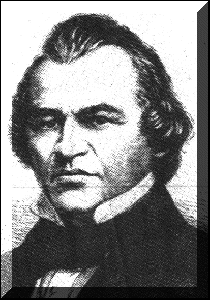
Andrew Johnson
|
The bitter division between the Republican
and Democratic parties during and after the Civil War was present on the national and
local scene. Sidney had two weekly newspapers during that time, the Shelby County
Democrat and the Sidney Journal. The papers traded bitter insults throughout
the war, with the Republican-based Journal accusing the Democrat of
traitorous conduct for opposing the war. In a blistering 1868 editorial, the Sidney
Journal accused the Democratic party of "controlling the states of the Rebellion;
giving aid and comfort to the rebels in arms during the war; discouraging enlistments in
the Union army and resisting the draft;" and being responsible for "high taxes,
high prices, and derangement of business, etc."
It was in this bitter, heated
environment that the impeachment of President Johnson took place. The rhetoric nationally
was, if anything, worse than on the local scene. Horace Greeley, editor of the New York
Tribune, referred to Johnson as "an aching tooth in the national jaw." As
the frustration grew over the failure of the President to sign laws that the Republican
Radicals pushed through Congress, the invective increased. One Republican representative
called the president "an ungrateful, despicable, besotted traitorous man - an
incubus."
There are some interesting parallels between the Johnson and Clinton impeachment sagas.
Both were born in southern states in relative poverty, raised by a widow, and became a
governor before assuming the Presidency. More than 130 years before Monica Lewinsky became
a household name, a woman named Jennie Perry charged the President Johnson with fathering
her illegitimate son.
Then as now, the issue of the public's right to know about the private life of its
public servants was a topic of discussion. The editor of the Sidney Journal expressed
the opinion of many in the July 3, 1868, edition of the paper. "When a man chooses to
leave the quiet of private life and enter the stormy arena of politics,...he must expect
his public foibles, acts and sayings...will be matters upon which criticism will be
directed." But as to his private life? The editor continued: "A man's private
doings and sayings are his own, and, as long as bounded by a proper respect for the rights
of his fellows, no one has a right to meddle therewith."
As partisan as we believe the 1998 debate in the House of Representatives was, it paled
in comparison to what occurred in the same chamber when our esteemed forefathers were in
charge. Adam Cohen wrote that one representative cried Johnson had dragged the robes of
his office through "the purlieus and filth of treason." Another called the
President's White House staffers "the worst men that ever crawled like filthy
reptiles at the footstool of power." Voting for impeachment was along party lines,
with 11 articles of impeachment delivered to the Senate on February 24, 1868.
In the small towns across America, little news on the impeachment trial made the local
newspaper. The Sidney's republican newspaper, the Journal, did not miss the chance
to take a swipe at the President, however. When new editor D. M. Bliss took over the Sidney
Journal during the spring of 1868, he castigated the Democratic party that had
"...so blindly followed Andrew Johnson in his treasonable and corrupting
designs." Mr. Bliss ironically ended his first editorial by pledging to "make
the Journal a good moral and instructive family paper."
At least one industrious Sidney
businessman thought Johnson's troubles presented a marketing opportunity. During the
trial, 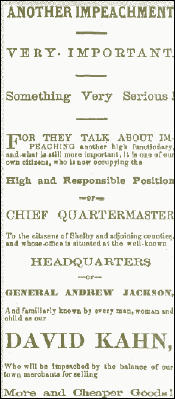 downtown merchant David Kahn paid for a newspaper ad that declared: "ANOTHER
IMPEACHMENT ...DAVID KAHN...WHO WILL BE IMPEACHED BY THE BALANCE OF OUR TOWN MERCHANTS FOR
SELLING...MORE AND CHEAPER GOODS!
downtown merchant David Kahn paid for a newspaper ad that declared: "ANOTHER
IMPEACHMENT ...DAVID KAHN...WHO WILL BE IMPEACHED BY THE BALANCE OF OUR TOWN MERCHANTS FOR
SELLING...MORE AND CHEAPER GOODS!
The Senate trial lasted two months. The
Johnson's lawyers, in a move being replicated now, presented a defense based on
mainly legal arguments. Johnson's conduct, it was asserted, did not violate the standard
created by the framers of the Constitution for 'high crimes and misdemeanors.' Momentum
began to switch to the side of President Johnson.
Sidney residents in 1868, most likely bored with the political name-calling, did not
have much of a reaction to the news of the Senate verdict, which acquitted President
Johnson by a single vote. The only mention of the result in the Sidney Journal the
next Friday appeared tucked away on one of the interior pages of the paper. "The
impeachment measure is now closed, and for the remaining few months of his term, 'A.J.'
can rest in peace, and go on with his corruption and rascality, with none to molest or
make him afraid."
President Johnson, seriously wounded politically, remained in office to finish out his
term. The Republicans stayed on the attack. Included in their 1868 presidential campaign
platform was a plank aimed at the president.
Downtown Sidney
businessman David Kahn tried to capitalize on the impeachment of President Andrew Johnson
with this ad claiming he would be impeached for selling "more and cheaper
goods." Sidney residents in 1868 did not have much of a reaction to the news of the
Senate verdict.
The Sidney Journal carried the 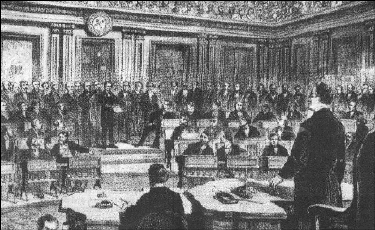 text.
They charged he "perverted the public patronage into an engine of wholesale
corruption"...and..."has been justly impeached and properly pronounced guilty
thereof by the votes of thirty-five senators." The details of his earlier acquittal
in the Senate were left out.
text.
They charged he "perverted the public patronage into an engine of wholesale
corruption"...and..."has been justly impeached and properly pronounced guilty
thereof by the votes of thirty-five senators." The details of his earlier acquittal
in the Senate were left out.
President Johnson retired to his home in Tennessee, but got
back into local politics almost immediately. He never got over the bitterness he felt
because of the impeachment trial. The former President finally made it back to Washington
almost a decade later as the newly elected senator from Tennessee. Johnson took his seat,
as the Senate opened, to thunderous applause. He suffered a series of strokes a few months
later, and died. His wife placed a copy of the Constitution under his head in the coffin
before he was buried.
The attire may be different but the reason behind this
gathering (shown below) of the Senate in 1868 is the same as the current session of the U.S. Senate. At
right, Thaddeus Stevens gives formal notice of the impeachment of Andrew Johnson.
[ Back to Politics Index ]