| Our forefathers had a dream and a vision
for this crook in the Great Miami River which was fulfilled with the establishment of a settlement. A town and place where men,
women and children could come together, to join in the birth of the new Ohio; proclaiming
the planting of new family roots. "What shall we call this place?" was
the preeminent question of the day. "Shall we name it in honor of Sir Philip
Sidney, valiant knight?" Although the debate took place less than 180 years ago,
the record and the arguments of the participants eludes even the most experienced
historians. The lone surviving element of that noble endeavor is our city and its name.
Did one of our founders wax eloquent support for Sidney, "A name of magnificence,
linked to this place of significance, shall forever proclaim the importance of this small
plot of land in the county of Shelby."
Was this thought planted by a Sir
Philip Sidney supporter in the minds of the men and women who chartered our fair community
less than two decades after this territory became a state, or was it simply borrowed from
the middle name of one of those early pioneers, Charles Sidney Starrett, who blew
the winds of life into our town’s humble beginning? Perhaps, Mr. Starrett himself had
been given the name Sidney by parents who likened him to the nobleman from England’s
16th century, or, if christened this way by chance, could it be that the young Starrett
was indeed honored that his name had become synonymous with a great individual from the
past?
Today, most of us believe, as do many of
Sidney’s long-time residents, that this place was named for the renowned Englishman,
Sir Philip Sidney. The plausibility for such a contention gains increased acceptance when
you place its rationale in the context of the times. This was an area controlled by the
English after the conclusion of the Seven Year War in Europe (following the Treaty of
Paris) until occupied by the new United States of America. Prior to Ohio’s statehood
and beyond the War of 1812, there was continued emigration to this territory by British
subjects imbued with the facts, legends and tales of their heroes. We see this expression
of pride in the preponderance of names attached to America’s cities, large and small,
whose origins are in the places and heroes of the old world. Sir Philip Sidney was a giant
of the old world, a man of honorable accomplishments who earned the love and admiration of
not only Englishmen, but of all men and women throughout Europe whose path he crossed. Born in the 16th century, (with the likes of Sir
Francis Drake as a contemporary), his noble deeds, volumes of literature and adventurous
spirit may have kindled something inside one of our town’s pioneers that caused him
or her to liken the beauty of this new place to the grandeur of a dead hero. And so, we
have for our city, a name with a splendid and heroic past.
As a community, we know little of the man to whom we
owe the name of our place, and yet there are literally dozens of tomes that recount the
deeds and writings of Sir Philip Sidney. Historians can produce personal letters written
in his own hand. We know the workings of his mind, the personality and character of his
being that led all that knew him to respect and admire him. In contrast, the life of
William Shakespeare is a mystery wrapped in a book cover that contains almost nothing of
his personal life, but volumes of his writings. There is not one historian alive, who, if
given the choice, would not prefer to discover a personal letter written by the bard, than
to come upon a previously unknown play. With Sidney, we are privileged to have both the
voluminous writings of the man, and the man himself.
I shall not bore you with the details of my
own life, since I am not the subject of this text; but suffice it to say that my close
association with Philip Sidney as a childhood friend and compatriot, throughout his short
span of adult years, adequately prepares me for the task of relating his story. Not
knowing where to start leaves me with only one option, and that is to start at the
beginning. This I shall do.
Philip was born into the prestigious family of the
Sidney's and Dudley's during the reign of the Tudors, seven years after Henry VIII died
and one year into the reign of Mary I. The day of his birth, November 30, 1554, at
Penshurst Castle in Kent, was a time of rejoicing for his father, Sir Henry, and his
mother Mary Dudley. His grandfather, Sir William Sidney, served Henry VIII with
distinction and honor. The family roots of the Sidney's, as conjecture has it, appear to
have consolidated their English connection during the reign of Henry II (1133-1189), after
having left the shores of France. Henry, by inheritance, conquest and marriage, was paid
allegiance by subjects in vast areas of France that were under his control, allowing
easier emigration to England. History, however, remembers him best for his great love and
anger directed at Thomas a Becket. Philip’s ancestor, William de Sidney, who is
presumed to have emigrated from France, served Henry as Chamberlain of his household.
My friendship with Philip began when he was just a
young boy. At the time our lives intertwined he needed the companionship of another lad,
since at home he was bound to interaction with three younger sisters, of whom he expressed
much affection. He would later enjoy the addition of three more siblings to the family;
another sister and two brothers. I should interject at this point, that the influence of
these sisters on Philip, and more particularly on his writings, established him in his own
time as a man who expressed a unique grasp of the personal and emotional traits of women,
treating them as equals. The writers of the times displayed an appalling lack of
understanding of females and their issues. Not so with Philip. In "Pyrocles to
Musidorus," he writes, "I am not yet come to that degree of wisdom to think
light of the sex of whom I have my life: since if I be anything...I was come to it born of
a woman and nursed of a woman...And truly, we men and praisers of men should remember,
that if we have such excellencies, it is reason to think them excellent creatures of whom
we are.... ." His equal treatment of women throughout his writings and his life
was a splendid example to everyone who cherished equality for all humankind. Philip and I were not without our moments of
introspection; indeed, as we would both become writers in later years, these times
provided invaluable experiences upon which to draw for written prose, and were the
happiest of my life. I remember one occasion specifically as we sat on the river bank with
the sun providing a summer warmth rarely seen in these shores. He recounted to me the
tragedies of the Dudley's, his mother’s family, beginning with the execution of his
great grandfather, Edward Dudley in 1510, followed by the execution of his grandfather
John, Duke of Northumberland, his uncle Guildford and aunt, Lady Jane Grey, all executed
in the year of Philip’s birth, 1554. Ben Jonson’s tribute to Philip’s birth
springs forth in eloquent prose, "That taller tree, which of a nut was set, at his
great birth where all the muses met..."
In 1564, at the 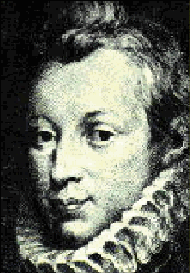 age of ten, we were both sent
to Shrewsbury Grammar School to be educated and to learn the disciplines and
responsibilities expected of young gentlemen. During a school break, Philip, with his
aristocratic connections, spent time with his uncle in Oxford where they entertained Queen
Elizabeth I for a full week. How I wished I could have been there. He did not tell me much
about the visit or his reaction to meeting the Queen. age of ten, we were both sent
to Shrewsbury Grammar School to be educated and to learn the disciplines and
responsibilities expected of young gentlemen. During a school break, Philip, with his
aristocratic connections, spent time with his uncle in Oxford where they entertained Queen
Elizabeth I for a full week. How I wished I could have been there. He did not tell me much
about the visit or his reaction to meeting the Queen.
I distinctly remember two years
earlier in 1562, his mother Lady Mary had nursed the Queen through a terrible bout with
smallpox, an occasion of which the nation feared the imminent death of its Monarch.
Elizabeth recovered without affect from the disease, however, Philip’s dear mother
herself contracted the virus and, although she recovered, was left with gross
disfigurement and mental suffering. This caused Philip’s father to effect separate
residences, households and retinues for himself and his wife.
With an honesty and closeness that belies true friendships, he recounted his bout with
measles and smallpox in the same year that his mother fell ill. It was as if I had never
observed his pockmarked features until that moment. His travails with this wretched
disease, unlike his mother, affected only his physical appearance, for inside was a human
being who had transcended the calamities of our sometimes fragile bodies. When I looked at
Philip, this was the Philip I saw and loved.
Our post grammar school education was followed by three years at Oxford University
where we studied the arts and sciences. Not content to devote his energies to limited
disciplines, Philip dashed undaunted into the whole spectrum of higher learning with a
confidence and comprehension that elicited praise from the masters.
Satisfied that Oxford had given all it could,
he later sped with much haste to Cambridge University to absorb all it had to offer. I
followed his tracks with much trepidation because even though I possessed a commendable
willingness to learn, in the long shadow of Sidney’s person, my successes appeared
insignificant. Such is the fate of those who choose to walk beside lifetime partners whose
stride forever increases.
In 1572, Philip crossed the English Channel on his first of
many ventures abroad. His distinguished companions included the highest of English
noblemen and me. In each and every country of Europe he visited, he generated the most
gratuitous affection. A reciprocated affection that kept us from England’s shores
until 1575. It was during his foray into Italy that the most contentious amongst his
admirers insisted vehemently that Philip met the great Tasso, Italy’s equivalent to
William Shakespeare. I know nothing of such a relationship and cannot verify or dispute
its validity, although, as a writer, Philip, knowing his close proximity to the Italian
bard, would have surely sought his counsel.
As the English Ambassador to Vienna in 1576, he was instrumental in convening and
forging an alliance between the states of Europe who opposed Rome and the particularly
cruel, (in the name of religion), country of Spain. On his return to England, he and I
were immensely surprised at the public outpouring of affection and admiration for his
accomplishments as a diplomat. The laurels placed upon this statesman, adventurer, author,
poet, playwright, by an adoring public were unsurpassed in England’s history, and are
embroiled and proclaimed in Queen Elizabeth’s continual reference to him as, "her
Philip."
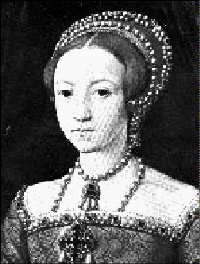
A young Queen
Elizabeth
That same year Philip’s betrothed sister
wed the Earl of Pembroke with much fanfare and celebration. Philip loved his sister Mary
with an incomprehensible passion in a time when women were simply icons of femininity,
with little else to offer. I knew he had many other sisters, and as we watched Mary take
her solemn vows, I asked him about the level of affection he had for them. Uncontrollable
tears of sadness erupted followed by a whispered response that left me with a renewed
understanding. You see, Mary was his sole surviving sister, for none of the others lived
to womanhood.
Having seemingly fallen out of favor in Elizabeth’s court where
detractors had gained the ear of the Queen, Philip used the time to write his
masterpieces. I wrote, too, but the fame was his. The genius of "Arcadia" came
with a greatness that even the likes of Shakespeare reached to borrow concepts for
characters, creating a legacy for those who followed him. As was the case with
Shakespeare, Philip’s works were not formally published until after his death.
The year was 1567. The bride was Frances Walsingham and the bridegroom was Philip
Sidney, but his heart belonged to Lady Penelope Devereaux a love and match that was lost
in time and eclipsed when she married another. Frances was quite beautiful but, respect,
an emotion much less than love, was her marital reward along with the birth of their
daughter Elizabeth who would later marry and die childless at the age of 27.
My friendship with Philip never wavered, although in reflection it was challenged on
January 13, 1583, when at Windsor Castle the Queen touched her sword to his shoulders with
an acclamation of knighthood that reverberated throughout the civilized world producing a
chorus of "Well done!" from all who knew him. His stride was now bolder
and longer, leaving me feeling unworthy and provoking a compelling need to stop running to
meet the pace of his walking stride. His assurances of everlasting friendship kept us
together. And so, we walked on.
During the 1580’s, Sidney’s thirst for adventure came to the fore once again
with his support for the escapades of such men as Sir Martin Frobisher and Sir Francis
Drake. His impending voyage with Drake from Plymouth was foiled when the Queen sent word
that she forbade Philip to leave England. He and I tried to circumvent the message and
authority of our sovereign by distressing the messenger, however, a further message and
subtle threats of retribution caused us to return to our homes. She did promise him a
position in Europe if he obeyed her command.
The Queen pondered her situation. She could give him the crown of Poland which was
available. His popularity in Europe was indisputable. I learned from Sir Robert Naunton
that Elizabeth looked unfavorably on this since she did not want to lose, "the
jewel of her crown." She therefore, nominated him as Governor of Flushing, the
highest position in the United Provinces, that included The Netherlands. We had been there
before, and Philip was anxious and ready to serve her majesty wherever she commanded. And
so, we left England’s shores behind once more with an unparalleled excitement on
Philip’s part, and uncertainty on mine. We landed in The Netherlands on November 18,
1585, to a proclamation, as our feet touched Dutch soil, that Philip was now a colonel of
the Dutch regiments and a captain of the English contingent that would engage the Spanish.
The fighting began, and Philip was promoted to the rank of General.
It was now 1586 and Philip suffered two blows
with his father passing on May 5 and his mother dying on August 9. With undaunted courage,
and remorse over the loss of his parents deep within his soul, we marched to relieve the
small town of Zutphen. The battle was fierce, but the victory was ours. A victory that
produced not only hope within the hearts of the Dutch but despair within the hearts of all
of England when rumors flooded the land that Philip Sidney had been injured in battle.
I
was at his side, when early in the battle his horse was shot from under him, and I gave
him mine. He fought brilliantly with a reckless courage that earned the respect of all who
saw him, from his rescue of Lord Willoughby to his multiple personal charges upon the
enemy. I cried, as did all who observed it, when a musket shot pierced his leg and
followed a course into his upper body. And so he fell, thirty two years from his birth, in
the same year of his parent’s death. Putting my pen to paper, I tried to express my
grief at the sight of my dear friend’s demise, but I could not. Posterity was not
cheated, however, for George Whetstone, a sonneteer who had also witnessed Sidney’s
tragic death wrote a moving poem.
It was September 22, 1586, and Sir Philip Sidney was mortally wounded. We took him by
barge to Arnheim giving him as much comfort as possible. His days were now filled with
pain and discomfort, yet he maintained an air of dignity. In fact, he composed his last
ode about the condition of his wound. The ode was lost to mankind in the immenseness of
our grief. Frances, his wife, had accompanied him to Zealand and was with him through this
ordeal to comfort and attend to his needs. On October 16, he uttered his final words to
his brother. Words that have meaning for us all and that remain etched in our memories of
this noble and loving man. "Love my memory," he murmured. "Cherish
my friends; their faith to me may assure you they are honest. But above all, govern your
will and affections by the will and word of your Creator; in me beholding the end of this
world with all her vanities."
I accompanied his body to London where he was interred at St. Paul’s Cathedral
with a pomp and circumstance reserved normally for kings and queens. A plaque was placed
over his tomb, that has long since been plundered by souvenir hunters. For your ears, I
utter it now: England, Netherlands, the heavens, and the arts, The soldiers, and the
world, have made six parts, Of the noble Sidney: for none will suppose, That a small heap
of stones can Sidney enclose. His body hath England, for she it bred; Netherlands his
blood, in her defense shed; The heavens have his soul, the arts his fame; All soldiers the
grief, the world his good name.
Philip’s widow, Lady Sidney would marry on two more occasions; bearing four
children, three girls and a boy. She passed away in 1632, forty six years after the
untimely death of her famous first husband. And so my story ends. Your small city of
Sidney, Ohio, gave recognition to a giant of the old world when you chose to use his name
for your fine community. Your growth through the years matches the long and determined
stride of Sir Philip Sidney. I am convinced that he would be proud to know his name lives
on in the new world.
[ Back to People Index ] |