| Judge Jacob Conklin gaveled
the meeting to order in his Probate Courtroom. As silence settled across the room, the
judge was probably quite pleased. Present were many of Sidney's community leaders,
including William Wyman, Civil War hero
Col. Harrison Wilson, tannery owner S. Alex
Leckey and Sidney Journal publisher William Binkley.
On the
judge's mind: the very future of the youth of Sidney. It was December of 1869, and there
were problems in town. The judge observed that "Saloons offered great inducements for young men
to congregate...where bad habits were contracted and vices cultivated." In his
estimation, "If young men had a place where they could get good and instructive
reading matter to spend their leisure hours, many of these temptations could be
erased."
Judge Conklin noted that, in contrast to this sad state of affairs, Sidney had at least
two literary and debating societies in the 1840's. He then concluded with a plea for
everyone in the community to support the idea of a debating society and library. The plan
was to make stock available for purchase in this newly formed enterprise. It was to be
called the Sidney Lyceum and Library Association.
The group organized with much pomp
and circumstance. A constitution and bylaws were drafted. The preamble to the constitution
intoned: "WE, the undersigned citizens of Sidney and the vicinity, for the
purposes of cultivating friendly and intellectual intercourse one with the other, to avail
ourselves of the opportunity of a frequent interchange of opinions upon questions of both
general and local interest...do hereby form ourselves into this association..." Apparently, the concept of a
debating society did not go over very well. History reflects that at least one debate was
held. After the debate on February 4, 1870 the Journal commented that it was not
well attended and "...it was not a very flattering success." Perhaps the
topic was part of the problem. It was: Resolved, that the right to vote be extended to women. It would be 50 years before society
would be ready for that.
Thereafter, efforts of the group
concentrated on the task of developing the library. The word "Lyceum," referring
to the debating activity, was later dropped from the name of the association. Some Sidney
residents purchased stock in the venture, but the price per share ($25) was too steep for
many. Binkley subsequently expanded the appeal in a later edition of the Journal: "We
might here state that the association is not intended to only benefit the people of
Sidney. Persons from any part of the county can purchase stock and enjoy the same
privileges of the association as those in Sidney."
Despite his appeal that the library
was a project that should "enlist the co-operation of every intelligent and
progressive man," only $1500 was raised. The funds were sufficient to finance the
purchase of 250 volumes. The books arrived in late May of 1870. A disappointed Binkley
announced on June 3 that "It is suggested that the ladies of Sidney host a
strawberry festival" to raise additional money. No one took him up on the
suggestion. The people of Troy were to do quite well with the idea a few years later.
William Binkley was appointed the first librarian. His pay: $5 per year. He opened the
library in a building owned by W.P. Stowell, which was located where the post office now
stands. The records reflect that the first book was checked out by James McKercher, a
local attorney.
The most difficult period in
the history of the library began with a decision that was initially met with much
approval. In 1879, the library trustees accepted a proposal from the trustees of the Monumental Building to move
to that location. However, the fine print of the agreement permitted the building trustees
to open the library "...as soon as the funds at their command will justify them in
doing so." After the move was completed, the building trustees refused to open
the library, citing financial problems. Literary darkness descended over Sidney for seven
long years.
The library reopened in 1886 under the guidance of the Hon William Wyman,
who had just retired as Probate Judge. Wyman was a fascinating character. Born in County
Wexford, Ireland, he left home at age ten, and worked as a cabin boy on sailing ships for
some time. Tiring of the sea, he made his way to Cincinnati, learned the plastering trade,
and eventually moved to Sidney. He helped construct the courthouse in 1881. Wyman
subsequently taught school in Orange Township. Prior to being elected Probate Judge, he
served as Mayor of Sidney.
Wyman was responsible for drafting
the first library rules and regulations. Only inhabitants of Sidney over 14 years of age
"known to the librarian to be responsible," or if unknown, "on
the written certificate to such responsibility of a known citizen" could withdraw
books to read. If one volume in a set was lost, the rules required the borrower to replace
the entire set.
The problems with the Monumental Building were not
over, however. The building trustees wished to expand the library in June, 1898. At that
point, the library association still used only the east portion of the second floor. The
rest was occupied by the Neal Post of the G.A.R., a group of civil war veterans
equivalent to the American Legion of today. The expansion plans were unveiled for the men
and they were asked to vacate the second floor. The vets refused, and the battle was on.
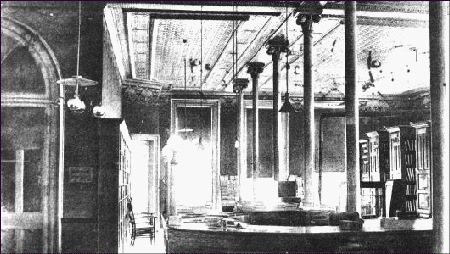
A turn of the century
interior view of the library
on the second floor of the Monumental Building
The soldiers retained
attorney David Oldham and the building trustees hired cagey, court room veteran S.L.
Wicoff. The legal and emotional fireworks lasted almost four years. Many of the war heroes
testified at the trial, pleading that the Monumental Building was built in honor of their
comrades, and with funds the soldiers helped raise. Evict the veterans from their own
building? The mere thought was preposterous. To make matters worse, the court fight pitted
the veterans against the trustees of the building, all of whom were also veterans.
The
trustees pointed to the original building plans, prepared by architect Samuel Lane, which
clearly showed the second floor as being reserved for a library. The judge ruled in favor
of the trustees. The soldiers appealed. The legal wrangling continued.....all the way to
the Ohio Supreme Court. The trustees prevailed, and the Civil War veterans left their
building in 1902.
In the years that followed, the
library grew steadily. It was expanded to the first floor of the Monumental Building in
1928. Service to county communities was initiated in 1941 with the opening of the first
branch library in Jackson Center. Finances, however, were always a concern. At various
times the association was funded by a real estate tax levy, Sidney school district monies,
intangible property taxes and general fund appropriations from the state of Ohio. By the mid 1940's, the library still
had no plans for its own home. All of that would change with the leadership of the General James Amos family. After coming to Sidney in 1876, Amos took over the Shelby County Democrat and
founded the Sidney Daily News in 1891.
He selected his daughter, Delia, to become the managing editor of the new venture. She was
the first women to occupy such a position in Ohio. At the time of her death in 1945, after
a successful business career, Delia Amos Smith left a substantial bequest in her will for
the construction of a new library. Other children of Gen. Amos, including attorney Frank
Amos and Emma Amos Pegg also made substantial gifts for the new building.
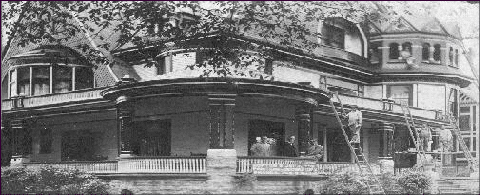
The Amos Memorial
Public Library was built on the lot of the William Piper house.
Photo courtesy of Phyllis and Vicki Piper, Pemberton.
Construction
of the Amos Memorial Library was completed and the dedication ceremony was held on
December 6, 1958. The guest speaker was Columbus Judge Roscoe Walcutt, the son in law of
Emma Amos Pegg. Noting that "All too frequently we have contempt for what has gone
before," Judge Walcutt emphasized that "only by knowledge gained from
books can we hope to develop the minds of our nation's young people and provide an
informed citizenry."
Frank Amos talked briefly on behalf of the
Amos family. In a response that characterized the quiet, effective leadership the Amos
family had given to Sidney over almost a century of service, he noted "...it is
not all one-sided. Down through the years Sidney has been good to us and this library
provides us the opportunity of expressing our appreciation." As the Amos Memorial Public Library
celebrates 125 years of service to our community, it is important to always remember the
commitment of citizens like William Binkley, Judge Wyman, and members of the Amos family,
without which institutions like the library would never exist.
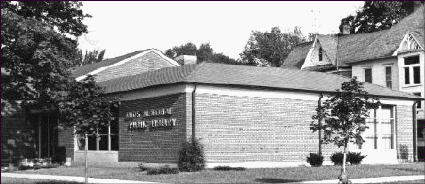
The Amos Memorial Public
Library as it basically appears today.
The home to the north is no longer there — it has been replaced by lawn, a parking
area and an apartment complex. The library’s address is 230 East North Street,
Sidney, Ohio.
[ Back to Downtown Index ] |