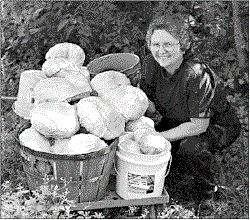
"First, have good cabbage. It
takes roughly two bushels for a ten-gallon crock,"
says Lew Diehl. And you need a willing worker, in this case, Pat Diehl.
An appealing characteristic of history is
that it remains a part of us one way or another. How many of us today continue to practice
customs handed down in our families for generations? Sauerkraut is a case in point. When the Historical Highlights editor
heard we were making sauerkraut, he said he thought no one did that any more. He thought
the tasteless, white stuff sold in the supermarkets was all there was. That led to the
suggestion of an article for our historical society newsletter. Kraut making can certainly
be said to be a part of Shelby County history, with all our German and other European
ancestors. What follows then is a self interview. — Lew and Pat Diehl
Lew: Making kraut is something I "came
home to" by way of Patty’s family. But this late summer work goes away back in
both our German families. My parents didn’t make any that I can remember, but my
grandparents, with their large family, made it by the barrel. Grandpa Diehl was descended
from immigrants to "Little Lampertheim," as Chillicothe, Ohio, was once known
after all the German gardeners settled there. He wrote of buying extra cabbage by the
hundredweight for the purpose. According to his mother’s diary, shucking corn and
making kraut were the last two jobs my great-grandfather did before dying of typhoid in
October of 1906.
Pat: Grandpa Kloeppel always had a big garden behind
their house on Highland Avenue in Sidney when there was only a big field there. I suppose
that’s where my father (George) learned about making kraut. After we moved to the
farm near Swanders in 1945, we had big gardens too, and I remember kraut making. It was
usually in October, when it was cool. The moon sign had to be right — going down, or
waning. Otherwise the kraut would swell and run over. We used big stone crocks. A crock was set near the chimney in the
basement so that it could help hold the cutter in place while slicing the cabbage. Later,
I would sneak down and snitch handfuls out of the crocks. I liked the taste of the salty
cabbage even before it was fermented. I can’t remember if they canned it or just left
it in the crock until it was gone.
Pat: We cooked it with pork. Grandma
would come out from town and make her dumplings to go with it. She had her own special
technique for making them, and they were cooked in the pot on top of the kraut. Nobody
could do it like she could. She would split those big dumplings open on the serving
platter and drizzle hot bacon grease over them before the pork and kraut were added.
Big Garden is First Step
Lew: When we settled in Shelby County, Ohio, in 1963, we began having big
gardens, and Pat’s folks got us started making kraut with the cabbage we raised. We
came by an old 1893 model kraut cutter and I fixed it up - even blued the blades to make
it look nice - then made a "stomper" out of a piece of seasoned red elm trunk.
We didn’t have a basement in our first house, and a batch went bad. You have to have
a cool place to ferment it. It’s gone well almost every time since, because we built
our own house after that, with a basement. One other time we didn’t have enough salt
in it and that batch went bad too. Too little salt, even if it doesn’t really go bad,
will allow growth of some yeast that make it turn red and have a weak flavor.
The time-honored way of making kraut, as we learned it anyway, is as follows:
First, have good cabbage. It takes roughly two bushels for a ten-gallon crock. If
you can raise your own, so much the better. It’s possible to make kraut of turnips or
even green beans, but we’ve never done that.
From Flat Dutch to Tropic Giant
Pat: We used to use Flat Dutch, but I tried raising different varieties
from seed, and Tropic Giant is our pick right now - very large, sweet, tight heads without
bitterness. When you make kraut is a matter of how soon you plant and when the cabbage is
ready. You can’t wait too long or the heads will burst in the garden. We usually
harvest in August or September, but it can be late as October. That’s when my folks
used to make it.
Kraut Cutters More Than Just Antiques
Lew: The special tools you need include a kraut cutter, which is a board
with side rails and with a couple sharp knives mounted in it. A box slides in grooves in
the rails. This holds the cabbage together while it’s being sliced. Cutters can
occasionally be found at a flea market or farm sale, or at an Amish hardware store like
Lehman’s at Kidron, Ohio. The stomper can be made of any dense, seasoned hardwood
that won’t impart a taste or absorb liquid, like elm, beech, or hard maple. It’s
just an upright cylinder about six inches high and wide, with a handle two or three feet
long. Cylindrical earthenware crocks complete the list. Everything must be very clean!
Other than the cabbage, the materials are simple. It requires only Kosher pickling
salt (no iodine!), and a bottle of beer for each participant. The cabbage is
stripped of all its outer, soiled leaves, then quartered, with the cores removed. Set a
crock o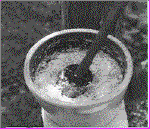 n the floor near a post or wall, with the cutter centered over it. Have a couple
clean throw rugs under the crock to absorb shock to help prevent breakage and, if in the
basement, to keep the chill of the floor from the kraut. The pieces of cabbage are then
placed in the cutter box, and run back and forth over the blades, which should be adjusted
for very thin shredding. This takes great care and attention, because you have to push
down hard on the cabbage, move it rapidly, and yet not include any parts of your fingers
in the kraut. A square piece of wood can be used by the fearful, but then you risk having
wood shavings in the cabbage. n the floor near a post or wall, with the cutter centered over it. Have a couple
clean throw rugs under the crock to absorb shock to help prevent breakage and, if in the
basement, to keep the chill of the floor from the kraut. The pieces of cabbage are then
placed in the cutter box, and run back and forth over the blades, which should be adjusted
for very thin shredding. This takes great care and attention, because you have to push
down hard on the cabbage, move it rapidly, and yet not include any parts of your fingers
in the kraut. A square piece of wood can be used by the fearful, but then you risk having
wood shavings in the cabbage.
Don’t Pound the
Bottom Out
Lew: When a few inches of shredded cabbage
are in the crock, salt is sprinkled generously over it. Getting the right amount is where
experience versus chance comes into play. (The books will tell you to use 3 tablespoons
per 5 pounds of cabbage.) Now the cabbage is pounded mercilessly, but without breaking the
bottom out of the crock like I did one time — another matter of experience. After
stomping until the salt is mixed in well, the resulting mixture should be quite salty to
the taste, yet not briny. If you are doing a good job, a cake of pressed cabbage will
build up on the bottom of the stomper.
The process of shredding in a couple inches of
cabbage, salting, pounding, and tasting is repeated again and again. The beer washes down
the salty cabbage in the taster. (That’s German!) As work progresses, the cabbage
begins to release juices and the mixture becomes very wet and easier to mix.
Beer is Important
Pat: Tasting the cabbage off the bottom of the stomper and following it
with beer is the best part, a family tradition. When you are certain the crock’s
contents taste right, and it is 2/3 full, a clean dish towel is placed over the kraut to
keep it from being exposed to air, and a dinner plate is turned down over that. This is
weighted down with something such as a clean plastic gallon vinegar jug filled with water.
(The old timers used a circular piece of wood with holes in it, and a granite fieldstone
— not limestone!) Finally, the crock is covered over with another towel and left in a
cool place for the microorganisms to start their organic chemistry. You may want to hold
off inviting neighbors over while the fermentation occurs.
Once a week, take out the inner towel and rinse the excess bacterial growth out of
it. Also rinse the weight and plate. After skimming off any softened cabbage from the top,
check the remainder for taste to see that it is progressing in the right way. Then
reassemble everything. It takes anywhere from about three to six weeks for the kraut to be
finished. You will know when it’s ready by the taste and smell, a matter of personal
preference.
If kept very cool after that, it can remain in the crock a while — but watch it!
In this day and age, it’s better just to put it up in quart jars and run it through
the pressure canner, 20 minutes at ten pounds pressure. Now it will last a long time. The
old way was to leave it in the crock or barrel, or "cold-pack" it in jars in a
copper boiler. If all has gone well, you now have a product that is nothing like the
cabbage and vinegar and lactic acid mixture that is sold for kraut at the store. When
partially browned pork chops or smoked sausage, or even humble wieners are cooked in it
and served with mashed potatoes or dumplings, you have an excellent old German meal.
Kraut Juice is Good to Drink
Lew: Patty thinks I’m crazy, but I believe the excess kraut juice, mixed
half and half with tomato, is very good for breakfast — beats the old orange juice
routine. Raw kraut and kraut juice are reputed to be very good for an upset stomach, and I
remember hearing it told how one of my aunts, the morning after a post-Prohibition
Saturday night, would go down to the basement for a bowl of kraut fresh from the barrel to
set herself straight. But mostly it’s just a fine food item, and it’s great to
have a row of jars full of it on your shelf for hearty wintertime meals.
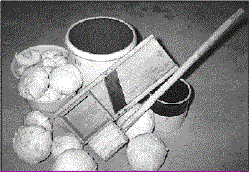
Parts list for making kraut: Cabbage (two
bushels for a 10-gallon crock), a kraut stomper (dense, seasoned hardwood), a cutter
(board with side rails and a couple sharp blades), and an earthenware crock. "A
bottle of beer for each participant" is not a requirement,
but is useful, according to Lew and Pat Diehl.
Kraut Our Forefathers Knew
Homemade sauerkraut was a common food among Shelby County farm families in the last
century. This recipe appeared in the local newspaper in 1882.
You should first cut off the loose, outside leaves, quarter the heads and throw
them into a tub of clean water, from which take out one piece at a time and place in a
small box open at top and bottom, and running in the grooves of the kraut machine, which
is about four feet in length, one foot in width, and six inches in depth. The box runs
over three or four knives, which may be made of an old scythe blade placed diagonally
across the bottom of the machine. The edges of the knives are slightly raised above the
level of the bottom, when the box is moved backward and forward in the grooves, and
pressure is made with a small piece of board on the cabbage, the latter is cut into thin,
small slices, which drop into the tub beneath the cutter.
As the cabbage is cut, put it into a clean barrel and pound with a heavy, wooden
mallet. The more closely it is packed the better. One pint of fine salt to the barrel is
sprinkled with the cabbage as it is packed down. No addition of water is required. Fill
the barrel to a point two inches from the top, cover the kraut with large cabbage leaves,
and place over the whole a wooden cover small enough to be inserted within the barrel,
where it must be kept firmly by a heavy stone until the process of fermentation is passed.
Place the barrel within five or six feet of the kitchen fire, and in a few days
fermentation will commence. A frothy substance will appear, which, if it does not run off,
should be removed. After four or five weeks it is ready for sale or use. Keep it in a cool
cellar (Shelby County Democrat, Aug. 25, 1882).

It’s tattered
and worn from long use, but Pat Diehl keeps the now illegible recipe for Kraut and
Dumplings her mother, Dorothy Kinninger Kloeppel, copied down in the late
1930’s. Pat says the recipe was handed down word of mouth from Grandma Kloeppel who
"would come out from town and make her dumplings to go with pork and kraut."
|