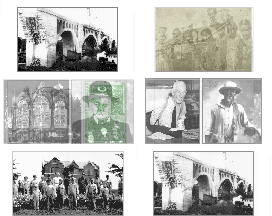
| Most communities had a
mill. Kirkwood’s once fed General
Harrison’s soldiers on the march. "Corn Cracker" built in Plattsville. Canal, then railroads, encouraged growth of the
industry. Several local brands of flour were produced in Shelby County, Ohio.
Grain elevators and mills were a common rural
industry, especially in Botkins, Anna, Jackson Center, Maplewood, Hardin Station,
Pemberton, and Russia, all with direct access to steam railroads. Allinger’s Mill, in Port Jefferson, had no railroad, but did have
direct access to the Sidney Feeder canal.
Sidney, triply blessed with feeder canal access to the Miami & Erie Canal and two railroads to foster grain shipments,
hosted a thriving milling and grain shipping industry. An artifact of that industry is the
Ginn Grain Company at North Street and West Avenue.
Even before large elevators, the countryside was dotted with mills to produce flour for
local use. Jackson Center’s first mill, for example, was built in 1839 by Daniel
Davis, and "was a horse mill, there being little or no access to water power in
this part of the county." In the area later platted as Pontiac, now Kirkwood, William Berry built a
flour mill in 1812. He reportedly ground meal for Harrison’s soldiers on the march to
the northwest. Lockington’s first flouring mill was erected in 1830. John Medaris
erected a mill --called a "corn cracker"-- near Plattsville around 1824 (Memoirs
of the Miami Valley, Vol. I, Robert O. Law Co., 1919).
Whiskey production, reducing a bulky corn crop to a profitable, compact item, was
popular at several milling enterprises. The old Maxwell mill on upper Mosquito Creek
"maintained...a small distillery—or old-fashioned copper still—which
produced a moderate amount of whiskey" (Memoirs).
Villages Benefited From Railroads
The D.T. & I. railroad, constructed in 1892, spurred growth in the small towns
along its route, helping them become centers for grain shipping. Jackson Center’s
Briggs elevator shipped from 150,000 to 200,000 bushels of grain each year, including
corn, oats, wheat, and rye early in this century. Buckland Milling company rivaled the
Briggs plant.
Construction of Maplewood’s two grain warehouses -- Stephenson’s (built in
1892) and The Farmers’ Grain Company (built by William Baker in 1894) -- meshed with
the rail construction. "When the D.T. & I. railroad came down from the north,
a new lease of life came to the neighborhood, and the village as it now stands has been
built almost wholly since 1892..." (Memoirs).
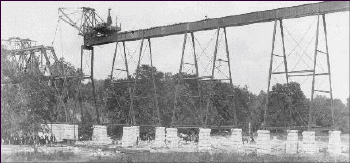
Final section of the D.T.& I. Bridge
over the Great Miami River near Quincy is lifted into place in 1892. This railway was a
business boon to Jackson Center and Maplewood, but hurt Port Jefferson. (Photo courtesy of
Bruce Davis, Franklin Township).
A boon to the towns hosting
it, the D.T.& I. spelled disaster to the by-passed Port Jefferson which once enjoyed
an active grain and milling industry supported by its position on the canal. Port had
attracted much of the grain from the farming districts to the north and east. "Then
the D.T.&I. railroad stole down on the eastern plain and seized all that was left of
Port Jefferson’s hopes, emptying its shops and leaving its once busy street a prey to
decadence" (Memoirs).
The Bellefontaine & Indiana railway
(later the "Big Four"), built in 1852, put Pemberton on the map: "...The
looming presence of two big grain elevators at the side of the steel artery of traffic
answers the question of what drew population to this spot." (Memoirs). The
two major grain elevators in Pemberton early in this century shipped about a quarter
million bushels of oats, corn, and wheat. One of them, the Shanely elevator built in about
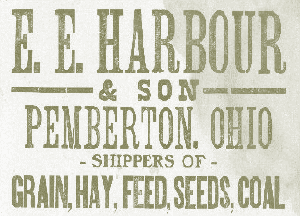
1903, was owned by L.G. Shanely and E.E. Harbour, a partnership which dissolved when
Harbour sold out to Shanely (Hitchcock’s History of Shelby County, 1913).
On the other side of Sidney, the Big Four railway facilitated large grain and livestock
shipments from the Hardin Grain company, just a mile south of town, the Snow & Ginn
elevator in Dawson, the Farmers’ Elevator near Houston, and the Groff & Simon
elevator in Russia. The Houston elevator, like others, supplied all sorts of goods for the
farmers, including coal, fencing, tiling, self-feeders, and seeds (Memoirs).
The north-south running Dayton & Michigan
Railroad, later the B.&O. was the rail outlet for oats, corn, and wheat for the Sheets
Grain Company and the Botkins Grain Company in Botkins: At the Botkins Grain company
elevator and mill, about 100,000 bushels of oats are handled annually, and 35,000 bushels
of wheat. The mill produces daily twenty-five barrels of "Kitchen Queen" flour,
and all varieties of feed and farmers’ supplies and implements are handled, including
seeds, coal, slat, fence posts, feeds, and tankage (Memoirs).
On down the
line, the Toland elevator and the Anna Farmers’ Exchange elevator qualified Anna as
"a 125-car town, referring to the amount of annual shipments. Swanders, two miles
south of Anna, also became an important grain shipping station, still operating today"
(Memoirs).
Kirkwood, south of Sidney on the B.&O. and site of the pre-1812 flouring mill when
the town was named Pontiac, hosted another important grain shipping elevator, owned at
various times by G.W. Holley, D. K. Gillespie who began buying grain in 1864, and Adlard
& Persinger of Sidney (Memoirs). Gillespie also built a large elevator in Lockington, later owned by C.N. Adlard.
Though not on a rail line, Kettlersville nonetheless had success with a large grain
storage warehouse... "built there for the convenience of farmers who cannot reach
the railroads" (Memoirs). But, the lack of transportation spelled doom for
the grist mill of Goins and Spray in Rumley,
just northwest of Anna. "The oncoming railroads took routes farther to the east,
and villages inevitably follow the railroads" (Memoirs).
Though Ft. Loramie had no direct access
to a large shipping rail company, its steam flouring mill, "the largest mill in
Shelby County...specialty is the Daisy O.K. flour," found its market via trucks
and the Western Ohio Electric, "a spur of which is Fort Loramie’s only
connection with a steam railroad" (Memoirs). Fort Loramie was also home to
the large Sherman Grain Company which also once used the Western Ohio track to handle
150,000 bushels of oats, 12,000 bushels of corn, 42,000 bushels of wheat, and 100 carloads
of coal each year. Another brand named flour, "Gold Coin," was produced by
Pasco’s flouring mill.
The mill stones long used by the mills to grind wheat and other grains began to give
way to modernization by the 1880’s, according to the Shelby County Democrat.
The new process consisted of "mashing the grain between rollers revolving at
different rates of speed, which makes better flour" (March 3, 1882). The Sidney
Grain Elevator, erected in Sidney in 1849 and converted to a steam flouring mill in 1853,
produced flour with "six run of stones," according to Sutton’s History
of Shelby County, Ohio, 1883.
Sidney Hosted Several Mills
The Sidney area was once home to a number of mills, including the Maxwell flouring mills east of town,
Cummins & Mathers in Dingmansburg just south of the Big Four tracks (before the tracks
were moved), an old grist mill owned by Hardesty Walker, and the Lamb and Zinn grain
warehouse and elevator at the intersection of Court Street and West Avenue (Memoirs).
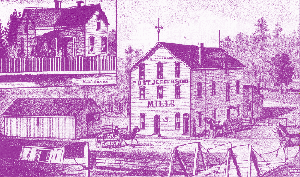
The Sidney Feeder canal furnished an outlet
for the Allinger mill in Port Jefferson
(illustration from Sutton’s History of Shelby County, Ohio, 1883)
The Maxwells built two mills before
acquiring flouring mills near Sidney. One was on their farm on the upper reaches of
Mosquito Creek east of Sidney. This mill also maintained a small distillery for whiskey
production. "The second mill...was located about two miles east of Sidney, where a
dam was erected...Here, distilling was done on a more extensive scale than on the farm,
the mill itself, erected primarily for the purpose of flouring, being larger" (Memoirs).
A third mill closer to Sidney, originally
built by John W. Carey, was
later acquired by the Maxwells. Production here was limited to flour milling. B.W. Maxwell
also acquired other mills, including another outfitted by Carey just east of Miami Avenue
and south of the canal, as well as the Cummins & Mathers grain mill in Dingmansburg. The mills east of the river were
powered by the Tawawa weir. Present residents of Sidney may recognize the location of the
water power source as described in Memoirs: The dam and spillway two miles up the
creek, and the picturesque race, are surviving features...and at the point where the
railroad (old Big Four rail bed) embankment forms an incidental dam, the back water of the
race has created a lakelet popularly called ‘Tawawa.’
The Hardesty Walker mill was built before 1840 along the Miami River opposite the
present location of Graceland Cemetery. "The current of the river is swift at this
point, and the now ruined dam below the bridge was constructed by Walker to turn this
power into the race which led past the foot of the mill bank" (Memoirs). A
later owner of the mill brought suit against the city for contaminating the mill’s
water supply when Sidney voided its first city sewer into the river above the dam. The
city settled out of court by purchasing the entire river bank south of the bridge to below
the mill for a park.
Allinger Family Prominent in Milling Industry
The Lamb and Zinn facility, erected in 1851, passed through several ownerships and
names, including "The Sidney Steam Elevator," until 1907 when it was
incorporated as the Miami Valley
Grain Company.
Officers were E.T. Custenborder, W.H.
Persinger, J.W. Allinger, and George Allinger. "The Allingers are a family well
known in the annals of the county as prominent in the grain and milling line, at Port
Jefferson, as well as at Quincy...where Ben Allinger of the Quincy mill is a brother"
(Memoirs).
The Allingers’ father was at one time in charge of the old Maxwell Mill. In the
1920’s, George Allinger recalled that..."Farmers at a distance would spend a
whole day coming to mill and at the old Maxwell mill east of Sidney quarters were provided
so the customers could put up their teams and had rooms provided in which they could cook
their meals and stay over night if necessary until they secured their grist" (Sidney
Daily News, Aug. 1927). The newspaper said "the name Allinger was synonymous
with good flour."
Emory C. Nutt in 1896 built another Sidney grain facility, once known as the Jones
Grain Company and later as the Sidney Grain Company. The building operates today as the
Ginn Grain Company at 132 W. North Street, the only such structure surviving in downtown
Sidney. Nutt should not be confused with Edmund E. Nutt, the Union officer hero of the Civil War who also engaged in Sidney’s
grain business as the owner of the Stone Bridge Warehouse, later Sidney Grain and Milling
Company.
The Sidney Grain and Milling
Company, later the Farmers Grain and Milling Co., was a major grain handling
establishment in Sidney and perhaps the oldest milling business there. The company proudly
advertised its "Triumph" flour made from Shelby County wheat, "which is
widely and favorably known and sold in northern and western Ohio, being sold by nearly
every grocer and flour man in this territory" (Industrial & Commercial
Sidney, Ohio, 1914).
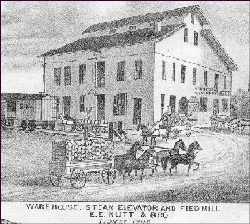
|
Warehouse
Steam Elevator and Feed Mill, E.E. Nutt & Bro., Sidney, Ohio
The "Stone Bridge Warehouse,"
later acquired by Farmers Grain and Milling. The new Sidney Fire Department occupies this
approximate site. Illustration from the New Historical Atlas of Shelby County, Ohio, Page
& Smith, 1875. |
The story of Sidney Grain and Milling was chronicled in a "civic pride"
booklet published in 1910 by the Amos printing company: Sixty years have witnessed great changes in Sidney and no spot more than
Poplar street at the old stone bridge. There for 50 years stood the old stone bridge
warehouse. Company after company owned and occupied it and grand fathers and fathers of
the present farmers delivered their grain.
Stood at Current Fire
Department Site
The Sidney Grain and Milling enterprise began in 1858 as the Stone Bridge Warehouse,
but the site was in the grain business long before that. Memoirs notes that: "The
site, on the west bank of the feeder canal, on the north side of Poplar street, was first
selected for a warehouse by Frazier & Frankeburger, in the 1830’s." The
warehouse, once destroyed by fire and then rebuilt, passed though several ownerships,
including the Nutt Brothers, the Griffis family, and later Capt. E.E. Nutt, the Civil War
veteran.
The building at one point had a capacity of about 50,000 bushels, with annual shipments
of 150,000 bushels (Memoirs). "This showing assumes extra proportions when
it is remembered there are thirteen other grain-dealing establishments within the county
outside of Sidney," wrote Sutton in 1883. This huge total of more than 700,000
bushels of county-wide storage capacity in 1883 pales in comparison with the capacity of
just one plant in 1999. Sidney’s modern Cargill soybean processing facility alone has
a storage limit of 3.2 million bushels.
Fred Russell, John Blake, and Frank Sayre purchased Sidney Grain and Milling in about
1912 upon the death of Capt. Nutt. They renamed it Farmers Grain and Milling. The company
maintained the manufacture of the "Triumph" brand of flour, and also handled
grain, seed, salt, coal, cement, plaster, hay, tile and straw (Hitchcock’s History,
p. 831).
There were no bulk deliveries of grain to the elevators in those days. "Dad would
load the back seat of our Overland, I think it was a 1912 model, with large cotton grain
sacks. These held about 2 1/2 bushels. He would take them out to the farm where they were
going to be threshing the next day," recalls Frank Sayre’s son Russell.
"The farmers brought the filled grain sacks to the mill in horse-drawn wagons."
Sidney Grain and Milling was modern for its time and boasted a quality product: Only
the best wheat that our Shelby County farmers raise is used. The present owner is the
Sidney Grain and Milling Company, incorporated to give it permanency, as men may come and
men may go, but an incorporation like the river may go on forever (1910 Amos Press
booklet).
Short-Lived Forever
The mill and its flour did not "like the river go on forever," as the
1910 civic booklet claimed it might. The local identity for Shelby County wheat in the
form of "Triumph" flour was lost as the modern successors to the old mills took
over. The current generation of grain handlers are the huge, multinational processors of a
wide variety of food and industrial products. Two such corporations operate in Shelby
County: Cargill (3.2-million bushel capacity) and
Archer-Daniels-Midland (1.3-million bushel capacity).
Mills Part of Local Literature
Ohio’s Sesquicentennial poet Maude Carey, of Sidney,
recognized mills in her epic poem of Shelby County’s history. Of Port Jefferson and
the canal, she wrote:
"Here’s Allingers who kept the mill
Where people came for miles around
With wheat and corn to get it ground
For every wife must bake her bread--
It was a duty when she wed.
Now near the mill across the pond
Honnell’s warehouse could be found.
They bought the grain and stored it well
Until the boat came and they could sell."
From History
in Rhyme, 1803-1953,
by Mrs. Maude A. Carey, 1953
|